
The piezoelectric transducer is the single component that makes the Levoit Dual 100 function as a humidifier. Every cubic centimeter of mist the unit produces, and every airborne water droplet that raises the room’s relative humidity, originates from the vibration of this one ceramic disc. Understanding what it is, how it works, what specifications define its performance, and what causes it to fail is not merely academic knowledge for repair technicians: it is the practical foundation for every maintenance decision an owner makes, from water quality choices to cleaning frequency to recognizing when the unit’s output has degraded below functional levels.
WHAT A PIEZOELECTRIC TRANSDUCER IS: THE PHYSICAL PRINCIPLE
The piezoelectric effect describes the property of certain crystalline materials, including lead zirconate titanate (PZT) ceramic, the most common transducer material in ultrasonic humidifiers, to generate mechanical stress when an electric field is applied, and conversely to generate an electrical charge when mechanically stressed. In the Levoit Dual 100, this property is exploited in the “reverse piezoelectric” direction: an alternating electrical signal applied across the ceramic disc causes it to mechanically vibrate at the frequency of the applied signal.
The critical engineering insight is in the frequency selection. The transducer in the Levoit Dual 100 operates at approximately 1.7–2.4 MHz, a frequency in the ultrasonic range, far above the threshold of human hearing (20 kHz). At this frequency, the disc surface vibrates with sufficient amplitude and acceleration to create a phenomenon called acoustic cavitation at the water surface directly above it: microscopic bubbles form and collapse in rapid succession, and the energy of this collapse ejects micro-droplets of water into the air as a fine mist. The droplets produced are typically 1-5 microns in diameter, small enough to remain airborne and evaporate quickly, producing the visible cool mist characteristic of ultrasonic humidifiers.
TECHNICAL SPECIFICATIONS OF THE LEVOIT DUAL 100 TRANSDUCER
The specific transducer parameters for the Levoit Dual 100:
Disc diameter: approximately 20mm (standard for compact ultrasonic humidifiers in this output class)
Operating frequency: approximately 1.7-2.4 MHz (exact frequency determined by disc thickness and PZT material composition, not user-adjustable)
Drive voltage: approximately 12-24V AC (produced by the unit’s internal oscillator circuit from the 24V DC regulated supply)
Power consumption at full output: approximately 10-15W (the majority of the unit’s total 18-20W rated consumption)
Mist output rate at maximum setting: approximately 250-300 mL/hour (manufacturer rated; actual output varies with water temperature and mineral content)
Droplet size: 1-5 microns diameter (cool mist; no heating of the water occurs)
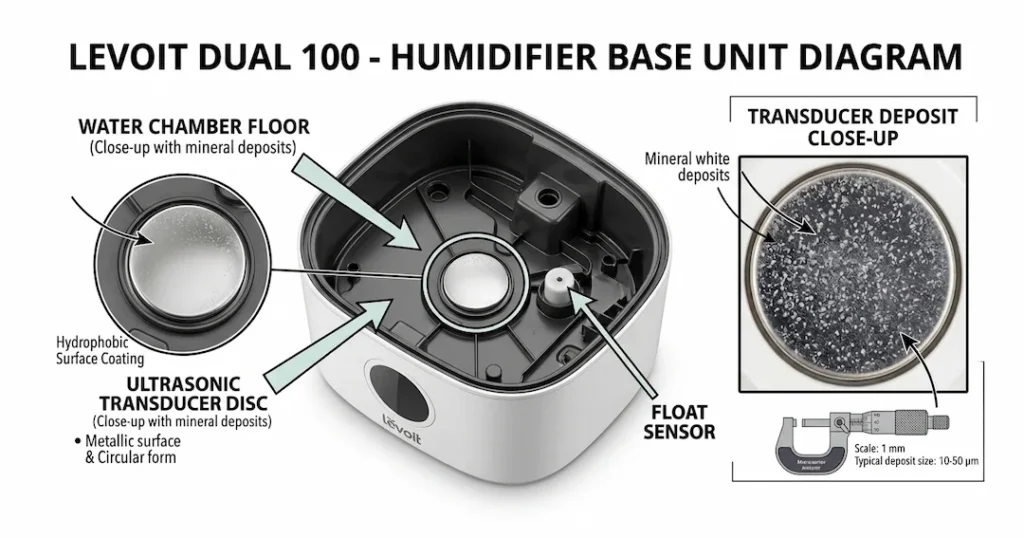
The transducer is a ceramic disc bonded to a thin metal diaphragm (typically stainless steel or brass), which in turn is sealed into the base unit’s water chamber. Water in the chamber sits directly above the transducer disc surface; direct water contact is required for the acoustic cavitation process to occur.
TRANSDUCER LIFESPAN: WHAT DETERMINES HOW LONG IT LASTS
A clean, properly maintained ultrasonic transducer in a compact humidifier has a theoretical operational lifespan of several thousand hours. In practice, the Levoit Dual 100 transducer’s effective lifespan is determined almost entirely by water quality and maintenance frequency, not by the hours of operation alone.
The primary lifespan determinant: mineral scale accumulation
Hard water contains dissolved minerals primarily calcium carbonate (CaCO₃) and magnesium carbonate (MgCO₃). When the transducer’s ultrasonic vibration atomizes water, dissolved minerals that were in solution are left behind as the water evaporates: they deposit as a white, hard mineral scale on the transducer disc surface and on the water chamber floor. This is the white dust phenomenon associated with ultrasonic humidifiers.
The mechanical problem that scale creates
The transducer’s function depends on its disc surface being in direct, unobstructed contact with the water. A mineral scale layer on the disc surface has two damaging effects:
1. It mechanically loads the transducer’s vibration
The disc must vibrate against the mass of the scale deposit in addition to the water above it, increasing the electrical drive requirement and causing the disc to operate at a detuned frequency (scale changes the mechanical resonant frequency of the disc-diaphragm system away from the designed operating point).
2. It thermally insulates the disc
The transducer generates heat at its base during operation. In a clean disc, this heat is conducted into the water. A scale-covered disc retains heat, causing the PZT ceramic to operate at elevated temperature, which accelerates depolarization (loss of piezoelectric activity) in the ceramic material.
These two mechanisms combine to progressively reduce mist output and eventually cause the disc to cease producing mist entirely while the oscillator circuit continues to operate normally; the disc simply stops responding at reduced power.
FAILURE MODES: HOW THE TRANSDUCER FAILS
Failure Mode 1 – Progressive mineral scaling (gradual output reduction)
The most common failure mode. Mist output decreases over weeks; the unit appears to be running normally (fan operating, power light active, no error indication), but the visible mist cone above the nozzle shrinks and eventually disappears. The disc is not dead; it is buried under scale.
This is a maintenance failure, not a component failure. Descaling with white vinegar as described in the companion guide How to Safely Descale a Levoit Dual 100 Using White Vinegar (Hard Water Scale Removal) restores full output in the majority of cases. A disc that produces no mist but responds to soft brushing of the disc surface (removing a visible white crust) has not failed; it is scaled.
Failure Mode 2 – Mechanical damage to the disc or diaphragm
Physical contact with the transducer disc surface, scrubbing with an abrasive pad, or pressing with a hard tool during cleaning can crack the PZT ceramic, damage the metal diaphragm, or destroy the bond between the ceramic and the diaphragm. A mechanically damaged transducer cannot be repaired and requires replacement.
Warning: the transducer disc surface should never be scrubbed with anything harder than a soft toothbrush or a cotton swab. The ceramic disc is brittle.
Failure Mode 3 – Ceramic depolarization from heat or dry operation
Running the humidifier when the water level has fallen below the minimum (the auto-off feature of the Dual 100 prevents this in normal operation, but a malfunctioning float sensor may allow it) causes the transducer to vibrate without water contact, generating heat that depolarizes the PZT ceramic permanently. A depolarized ceramic disc produces no piezoelectric response and cannot be reprogrammed; replacement is required.
Failure Mode 4 – Age-related adhesive failure
The bond between the PZT ceramic disc and the metal diaphragm uses a specialized adhesive (typically an epoxy or a conductive adhesive that also provides the electrical path to the disc’s ground electrode). Over many years of thermal cycling and ultrasonic vibration, this bond can fatigue and develop micro-cracks. This produces a disc that works intermittently, functioning in some positions or water depths but not others.
TRANSDUCER REPLACEMENT PARTS
The Levoit Dual 100 transducer is available as a replacement part from Levoit directly (contact support with the model number) and from third-party suppliers who sell compatible 20mm ultrasonic transducer discs. When ordering a replacement:
- Confirm disc diameter (20mm for Dual 100; do not use 16mm or 25mm variants)
- Confirm operating frequency compatibility (1.7–2.4 MHz)
- Order the transducer-diaphragm assembly (disc already bonded to the metal diaphragm plate) rather than a bare ceramic disc; bonding the ceramic to the diaphragm without specialized equipment produces unreliable results
EXTENDING TRANSDUCER LIFESPAN: PRACTICAL GUIDANCE
The single most impactful decision an owner makes for transducer longevity is water quality. Distilled water contains no dissolved minerals and produces zero scale accumulation on the transducer disc, extending its effective lifespan indefinitely relative to hard tap water. Filtered water (reverse osmosis) is the next best option. The water quality implications for the Dual 100’s components, including the white dust phenomenon and its effects, are covered in detail in the companion guide Can You Use Tap Water in Levoit Dual 100? (White Dust Prevention Guide).
For owners using tap water, weekly cleaning of the transducer disc surface with a soft brush and a white vinegar soak removes mineral scale before it can accumulate to damaging thickness. This maintenance interval, adjusted based on local water hardness, is the most effective way to sustain full mist output and protect the transducer against scale-driven failure.