

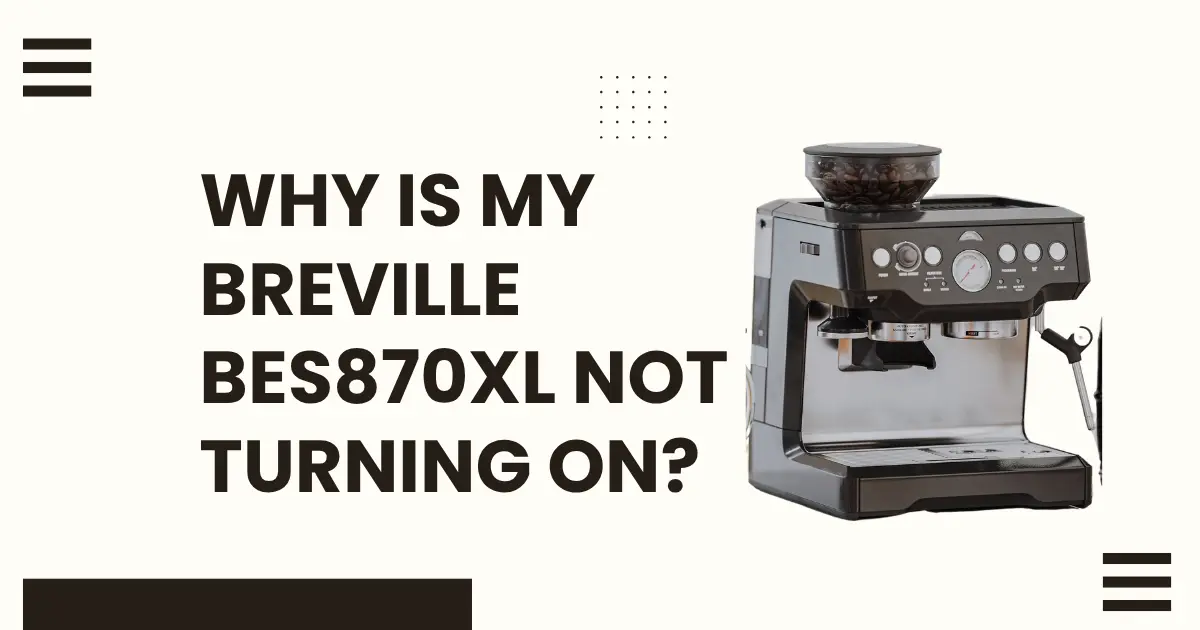
If your Breville BES870XL shows no lights, no display, and no response when you press the power button, the problem may be simpler than a failed internal component. A dead outlet, tripped GFCI, damaged power connection, or blown internal fuse can all make the machine appear completely lifeless, while less common faults such as a failed thermocoil, power switch, or control board can produce the same symptom. In this guide, we’ll explain the most likely reasons your BES870XL isn’t turning on, how to work through the power system safely from the outside in, and how to tell when the problem can be resolved with a simple reset versus when professional repair is the safer option.
Why ‘Not Turning On’ Needs to Be Defined Before It Can Be Fixed
A machine that “won’t turn on” sounds like a single, simple problem, but in practice it’s a symptom that several completely different faults can produce, and each of those faults sits in a different part of the machine’s power delivery chain. There’s a meaningful difference between a machine that shows absolutely no sign of life at all, no lights, no display, no sound, and a machine that flickers briefly and then dies, or one that turns on but then shuts off again after a few seconds. There’s also a meaningful difference between a problem that started suddenly, out of nowhere, and one that followed a specific event, such as a power outage, a spill near the machine, or plugging in another high-draw appliance on the same circuit. Before touching any internal component, it’s worth spending sixty seconds mentally walking through exactly what happened and exactly what the machine is or isn’t doing, because that detail changes which of the following causes is actually the most likely one.
The power chain on the BES870XL can be thought of as a sequence of checkpoints: the wall outlet, the household circuit and its protective breaker, the machine’s own power cable and internal fuse, the physical power switch, and finally the internal control board that everything else answers to. A failure at any single checkpoint will produce the same outward symptom: a dead, unresponsive machine, even though the fix at each checkpoint is completely different. Working through them in order, from the simplest and most external to the most internal, is the fastest way to arrive at the actual cause without unnecessary disassembly.
Most Common Causes, Ranked by Likelihood
1. The Outlet or Circuit Isn’t Actually Delivering Power
This sounds almost too obvious to mention, but it’s genuinely one of the most common causes reported, particularly on kitchen circuits that share a breaker with other high-draw appliances. Test the outlet with a different device, a phone charger or a lamp, before assuming the machine itself is at fault. If the outlet is on a Ground Fault Circuit Interrupter, it may have tripped without an obvious visual cue depending on the outlet design, silently cutting power to everything downstream of it while looking, at a glance, like it’s still active.
2. A Tripped GFCI Outlet
Kitchen outlets near sinks are very commonly wired through a Ground Fault Circuit Interrupter for safety, and espresso machines, which combine water, heat, and electricity in close proximity, are one of the more common appliances to trip one, even without any actual fault in the machine itself. This is different from a simple power interruption because the outlet has actively detected a leakage current and deliberately cut power as a protective measure, and it needs to be manually reset rather than just waiting for power to return. If your machine has tripped the outlet more than once, or trips it consistently rather than as a one-off event, that repeated pattern points toward a genuine internal fault rather than coincidence, and it’s covered in focused detail under why the BES870XL trips the GFCI, which is worth reading if this is a recurring rather than one-time issue.
3. Blown Internal Fuse
Like most espresso machines with a heating element, the BES870XL has an internal thermal fuse designed to protect the machine from a genuine electrical fault by breaking the circuit permanently before anything more serious, like a fire risk, can occur. This fuse is a one-time, non-resettable component: once it blows, it stays blown, and the machine will show absolutely no power at all afterward, regardless of the outlet or switch condition. A blown fuse is most often the end result of an underlying issue elsewhere, such as a heating element that drew excessive current, rather than a random, unprompted failure, which is why fuse replacement alone sometimes doesn’t permanently resolve the underlying issue if the root cause isn’t also addressed.
4. Failed Thermocoil or Heating Element
The thermocoil is responsible for heating water on its way to the group head and steam wand, and it draws a significant amount of current whenever it’s active. A thermocoil that has failed, through age, scale-related overheating, or an internal short, can, in some cases, draw enough excess current to blow the internal fuse or trip a GFCI outlet, which means the visible symptom of “machine won’t turn on” can actually originate from a heating component rather than the power switch or control board at all. This overlaps closely with broader heating problems on the machine, and it’s worth reviewing why the BES870XL isn’t heating up if the machine has shown any signs of inconsistent or weak heating in the period leading up to it losing power entirely, since a gradually failing thermocoil often produces warning signs before it fails completely.
5. Faulty Power Switch or Control Board
If the outlet, GFCI, and internal fuse have all been checked and ruled out, the remaining possibility is a genuine failure of the physical power switch itself, or the control board that the switch and display both answer to. This is the least common cause in practice, but it’s also the one that most clearly requires professional service rather than a DIY fix, since it typically involves diagnosing and replacing an electronic component rather than a simple mechanical or consumable part.
Diagnostic Sequence: Working Through the Checkpoints in Order
Rather than guessing which of the five causes above applies, work through the machine’s power chain in the following order. Each step is designed to be quick, safe, and non-invasive, ruling potential causes in or out before you move toward anything that requires opening the housing.
- Confirm the wall outlet itself has power by testing it with a different appliance.
- If the outlet is a GFCI type, press the reset button firmly and listen or feel for a click before trying the machine again.
- Try a different outlet entirely, ideally on a different household circuit, to rule out a tripped breaker elsewhere in the panel.
- Inspect the machine’s power cord for any visible damage, kinks, or scorch marks near the plug or the point where it enters the machine.
- If the machine has previously shown weak or inconsistent heating, treat the thermocoil as a stronger suspect and proceed with additional caution.
- If everything upstream checks out and the machine still shows zero signs of life, the internal fuse, power switch, or control board are the remaining suspects, and this is a reasonable point to involve a qualified technician rather than opening the housing yourself.
Why a One-Time GFCI Trip Is Different From a Blown Fuse
It’s worth being precise about the distinction between these two failure modes, because they’re often confused and they call for completely different responses. A GFCI trip is the outlet protecting itself and the circuit from a detected leakage current, and it resets with a simple button press; the machine itself may be completely fine, and the trip may have been triggered by something as minor as ambient humidity around the outlet. A blown internal fuse, by contrast, is the machine’s own protection responding to an actual fault condition inside the unit, and no amount of resetting an external outlet will bring the machine back to life, because the break in the circuit is happening inside the appliance itself, not at the wall. If resetting the GFCI restores power immediately and the machine runs normally afterward, the fuse was never the issue. If resetting the GFCI does nothing at all, the fuse or another internal component becomes the far more likely explanation.
When the Machine Turns On but Then Shuts Off Again
A slightly different but related symptom is a machine that briefly powers on, lights flash, the display shows something, and then shuts off again within a few seconds. This pattern usually points away from a simple outlet or fuse issue, since those would prevent the machine from showing any life at all, and points instead toward the control board detecting an internal fault condition during its brief startup self-check and deliberately shutting back down as a protective measure. This is more consistent with a heating-element or sensor-related fault than a pure power-delivery issue, and it’s worth treating as a separate diagnostic path from a machine that shows absolutely nothing when plugged in.
Water and Electricity: Why Spills Matter More Than They Seem To
Because the BES870XL combines a water reservoir, a drip tray, and electrical components in close physical proximity, water intrusion is a more common cause of sudden power failure than most owners expect. A minor spill or overfill event that seems harmless at the time can migrate into the base of the unit and cause exactly the kind of leakage current that trips a GFCI outlet, and in more serious cases, can contribute to the fault that eventually blows the internal fuse. If your power loss followed shortly after a leaking water tank or an overfilled reservoir, that timing is a meaningful diagnostic clue rather than a coincidence, and the machine should be left unplugged and allowed to dry out fully before any further troubleshooting is attempted.
What Not to Do
- Don’t repeatedly reset a GFCI outlet more than two or three times if it keeps tripping immediately; this usually confirms a genuine internal fault rather than a fluke, and repeated forced resets don’t fix the underlying cause.
- Don’t attempt to open the housing or access the internal fuse or control board without unplugging the machine first and allowing it to fully depressurize and cool.
- Don’t assume the power cord is fine just because it looks undamaged; a partially broken internal wire inside the cord can cause intermittent power loss without any visible external sign.
- Don’t ignore a machine that powers on and then shuts off again, treating it as “working”; this is a fault pattern, not a normal startup behavior.
Preventing Power Failures Going Forward
- Avoid overfilling the water reservoir, and wipe up any spills near the base of the machine immediately.
- Don’t run the BES870XL on the same circuit as other high-draw kitchen appliances if you can help it, particularly ones that cycle on and off frequently, like a refrigerator compressor.
- Keep the drip tray emptied regularly so it never overflows onto the surface the machine sits on.
- Descale on schedule; scale buildup contributes to the kind of heating-element strain that can eventually lead to a blown fuse.
- If the machine has ever shown early warning signs like inconsistent heating or occasional flickering, address them promptly rather than waiting for a full power failure.
Frequently Asked Questions
Is it safe to keep trying to plug the machine back in if nothing happens
A couple of attempts after confirming the outlet works is reasonable, but repeated attempts with no change in outcome won’t reveal anything new, and it’s better to move through the diagnostic checkpoints methodically instead.
Can a power surge cause this without an obvious storm or outage?
Yes, brief voltage fluctuations from other appliances cycling on the same circuit can sometimes be enough to trip a sensitive GFCI outlet or, in rarer cases, stress an already-weakened internal component, even without a dramatic, obvious surge event.
Does a completely dead machine always mean I need a technician?
Not necessarily; outlet issues and GFCI trips account for a large share of “dead machine” reports and are entirely user-resolvable. A technician becomes necessary once outlet, GFCI, and cord checks have all been ruled out, and the machine still shows no response.
Why did my machine work fine yesterday and show nothing today with no changes on my end?
Sudden, unprompted power loss without any preceding symptoms is most consistent with a GFCI trip or a household circuit issue rather than a gradual internal fault, since component failures inside the machine are more often preceded by some warning sign, however subtle.