
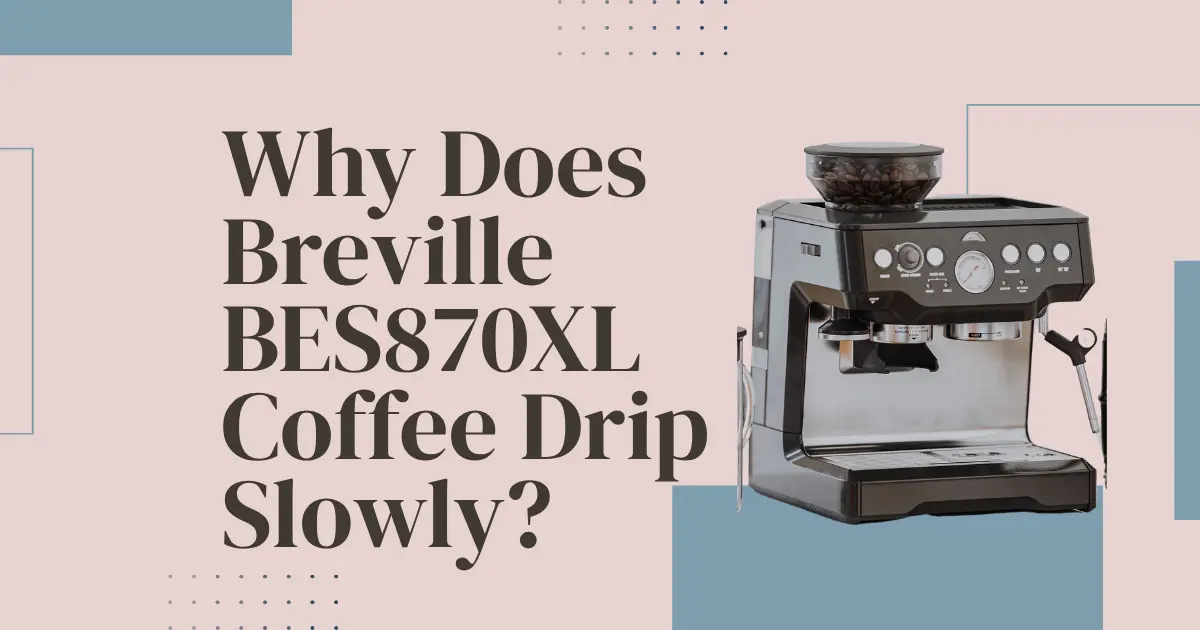
When coffee drips slowly from a Breville BES870XL portafilter, taking 40, 50, or even 60 seconds to fill a double shot when it should take 25-30 seconds, the machine is communicating a specific imbalance between the resistance the coffee puck is creating and the pressure the pump is generating to push water through it. Slow drip is one of the most frequently misdiagnosed problems on the BES870XL because it exists at the intersection of two systems: the grinder and the pump-and-flow pathway. A slow drip caused by an overly fine grind requires a completely different fix than a slow drip caused by low pump pressure or scale blockage, and applying the wrong fix wastes time and can make the actual problem worse.
This guide works through every cause of slow-dripping coffee on the BES870XL in the correct diagnostic order, beginning with the most likely causes and progressing to the mechanical failures that require internal repair.
WHAT “SLOW DRIP” MEANS IN ESPRESSO EXTRACTION
Before diagnosing the cause, it’s important to establish what slow-dripping coffee actually means for espresso quality on the BES870XL. A correctly extracted double espresso shot (approximately 36-38 grams output from 18-20 grams of ground coffee) should take 25–30 seconds from the moment water contacts the puck. The pressure gauge should read in the 8-10 bar range throughout extraction.
When extraction time exceeds 35-40 seconds, the espresso is over-extracted; it will taste bitter and harsh regardless of coffee quality. When extraction takes more than 50 seconds, coffee is often dripping so slowly that the espresso is undrinkable, and something beyond grind adjustment is wrong.
The pressure gauge is the first diagnostic tool: during a slow drip extraction, watch where the needle sits. If the needle is in the 10-12 bar range (or above), the puck resistance is too high, a grind, dose, or tamping problem. If the needle is in the 4-7 bar range despite the slow drip, the pump is undersupplying pressure a mechanical or scale problem.
CAUSE 1: GRIND TOO FINE (HIGH PRESSURE READING)
The most common cause of slow-dripping coffee on the BES870XL is a grind that is too fine for the dose and tamping force being used. The BES870XL’s integrated grinder produces grinds ranging from very coarse (setting 1) to very fine (setting 16+), and coffee ground at the finer end of the range creates a dense puck that the pump must push harder to penetrate. When the grind is too fine, even at the correct 9-bar pump output, water finds very few channels through the puck and drips through slowly.
The pressure gauge confirms this
A grind-related slow drip shows a high gauge reading (10-12+ bar) during extraction, because the pump is developing full pressure but the puck resistance exceeds the pump’s normal operating range.
Fix
Adjust the grind setting one or two numbers coarser. On the BES870XL’s integrated grinder, make grind adjustments only while the grinder is running; never adjust the grind setting while the grinder is stopped, as this can jam the burrs. If the integrated grinder has been used at a very fine setting for extended periods, the burrs may have worn and require recalibration. The Breville BES870XL Upper Burr Adjustment Guide for Better Grind Consistency covers the precise calibration method for restoring grinder accuracy after setting drift.
CAUSE 2: OVER-DOSING OR OVER-TAMPING (HIGH PRESSURE READING)
Dose and tamping pressure combine with grind size to determine total puck resistance. Even with a correct grind setting, using significantly more coffee than the basket’s rated dose (overfilling a double basket beyond 20-21 grams, for example) creates a puck that is too dense for water to penetrate in 25-30 seconds. Similarly, tamping with significantly more than 30 lbs of pressure increases puck density beyond the optimal range.
Diagnosis
Measure the dose before tamping. The BES870XL’s dual-wall baskets are sized for specific dose ranges: the single basket for 7-10 grams, the double basket for 14-18 grams. If using the precision single-wall baskets, the dose range is tighter, and over-dosing is more consequential. Tamp to 30 lbs of pressure (approximately the force needed to compress a bathroom scale from a comfortable standing position to the point of weight distribution across your palm).
CAUSE 3: MINERAL SCALE IN THE FLOW PATH (LOW OR NORMAL PRESSURE READING)
Mineral scale accumulating in the thermocoil, the solenoid valve, and the group head flow path progressively narrows the internal passages through which water must travel to reach the puck. As these passages narrow, the effective flow rate decreases; the pump can maintain its pressure output, but the volume of water delivered per unit time to the puck reduces. The result is a slow drip that is not caused by the puck’s resistance but by the machine’s inability to deliver adequate water volume through the restricted internal passages.
Pressure gauge reading during scale-related slow drip
The gauge typically reads in the normal range initially, then may drop as the pump works against scale restriction at sustained extraction time. The pattern differs from grind-related slow drip, where the gauge immediately reads high from the start.
Scale-related slow drip develops gradually; the extraction time increases over weeks or months, not suddenly. If shots that were previously 25 seconds are now taking 35-40 seconds and no grind or dose change has been made, scale is the most probable cause.
The fix is a complete descaling cycle
The full procedure, including the descaling solution selection, step-by-step flush process, and rinse cycle, is covered in How to Descale Breville BES870XL Properly. Performing a thorough descaling cycle, including a dwell period that allows the descaling solution to work on the solenoid valve’s small orifices, restores flow through the internal pathway and brings extraction time back to normal.
CAUSE 4: CLOGGED SHOWER SCREEN OR GROUP HEAD
The shower screen, the perforated metal disc at the top of the group head that disperses water evenly across the puck surface, accumulates coffee oils and dried grounds with every extraction. A clogged shower screen unevenly distributes water across the puck surface, promoting channeling and reducing the total flow rate from the group head to the puck. This produces a slow, uneven extraction where some areas of the puck are over-extracted while others are under-extracted.
Observable sign
Water drips unevenly from the portafilter spouts during extraction; one spout drips while the other runs at normal speed, or the extraction stream spirals rather than flowing straight down.
Fix
Backflush the group head using a blind basket (solid, no-hole basket) and Cafiza espresso machine cleaner. The backflushing procedure forces water and cleaner backward through the group head, dislodging coffee oil residue from the shower screen and the group head seal. Remove and physically clean the shower screen with a soft brush and Cafiza solution every 2–4 weeks depending on usage. The detailed cleaning procedure is covered in How to Clean the Breville BES870XL Group Head.
CAUSE 5: LOW PUMP PRESSURE (LOW PRESSURE READING THROUGHOUT)
If the pressure gauge reads consistently below 8 bar throughout the extraction, not just at the end, but from the moment water contacts the puck, the pump is not developing adequate pressure. This can occur from:
Pump wear and reduced pressure output
The BES870XL’s vibration pump degrades over thousands of brew cycles, eventually producing lower maximum pressure than its 15-bar rated capacity. When effective extraction pressure drops below 8 bar, even a correctly ground puck produces a slow drip because the pump cannot push water through the puck at the correct rate.
Air lock in the pump
The pump contains air rather than water (from running the tank empty or from storage), preventing it from developing pressure.
Kinked or damaged internal water line
The silicone tubing connecting the pump to the thermocoil can develop a kink from improper reassembly after service, reducing flow and pressure.
Low pump pressure is a separate diagnostic pathway from grind and scale issues. The complete pump assessment and replacement procedure is covered in Breville BES870XL Water Pump Replacement Step-by-Step Repair Guide.
CAUSE 6: PORTAFILTER GASKET DEGRADATION
The group head gasket (the rubber seal that the portafilter locks against when inserted) can degrade over time, hardening, cracking, or losing its compression profile. A degraded gasket does not seal the portafilter-group head interface correctly. Water takes the path of least resistance: instead of passing through the puck under full pump pressure, some water bypasses the puck through the degraded gasket seal. This reduces the effective pressure on the puck, slowing extraction time even when the pump itself is performing correctly.
Observable sign
Water leaks around the portafilter during extraction (dripping from the portafilter collar or spraying from the side), and the extraction is slow. A portafilter that requires unusual twisting force to lock, or one that locks at a different angle than when the machine was new, also indicates a compressed or degraded gasket.
The portafilter leaking and gasket replacement procedure is covered in How to Replace a Breville BES870XL Group Head Gasket.
DIAGNOSTIC DECISION TREE
Check pressure gauge during extraction:
- Gauge reads 10+ bar: grind too fine, overdosed, or over-tamped
- Gauge reads 8-10 bar (normal), but shot is slow: clogged shower screen or scale in flow path
- Gauge reads below 8 bar consistently: pump pressure issue, air lock, or gasket bypass
- Water visible around portafilter collar: group head gasket failure