
Noise from the Breville BES870XL grinder is one of the most commonly reported complaints among owners, but not all grinder noise is equal. The BES870XL grinder is inherently louder than standalone conical burr grinders because its motor, burr set, and grinding chamber are housed within the same chassis as the espresso machine, without the vibration dampening that a separate appliance would have. However, there is a clear boundary between expected operational noise and noise that signals a problem requiring attention.
Baseline: What Normal BES870XL Grinder Noise Sounds Like
Under normal operation with fresh, dry whole beans and correctly maintained burrs, the BES870XL grinder produces a consistent mid-pitched motor tone combined with the cutting sound of beans passing through the conical burrs. This sound has a relatively uniform character throughout the grinding cycle, with a brief pitch change at the start (as the motor reaches operating speed) and a brief higher pitch at the end (as the last beans clear the chamber). Any noise that deviates significantly from this baseline irregular rhythm, metallic scraping, sharp impacts, or a grinding metal character indicates a problem.
Cause 1: Foreign Object in the Grinding Chamber
Sound signature: metallic clattering or sharp impact sounds
A sharp crack, persistent metallic rattling, or intermittent impact sounds during grinding almost always indicate a hard foreign object in the grinding chamber. This is the most urgent noise scenario because continued grinding with a foreign object present can chip or shatter the burr teeth, distributing metal fragments through the grounds.
Immediate Action Required
Stop the grinder immediately. Unplug the machine. Do not attempt to grind through the noise. Follow the foreign object jam procedure in Breville BES870XL Grinder Jammed? Easy Fix Guide to safely extract the object.
Cause 2: Worn or Damaged Burrs
Sound signature: consistent abrasive grinding sound
Worn burrs produce a characteristically coarser, more abrasive grinding sound than new burrs. As the cutting edges dull, they require more force to process each bean, and the motor works harder. The sound takes on a grinding, rough character compared to the cleaner cutting sound of sharp burrs. This noise type typically develops gradually over months and worsens progressively. It is usually accompanied by declining grind consistency and increased extraction variability. There is no fix for this noise short of burr replacement; cleaning will not restore dull burr edges. The sound is a performance indicator telling you that the burrs have reached the end of their useful life.
Cause 3: Partially Emptied Hopper Causing Bean Bouncing
Sound signature: irregular clicking or light impact sounds
When the bean hopper is between one-quarter and one-half full, the remaining beans can bounce unpredictably before entering the grinder feed throat. This creates an irregular clicking or pattering sound as beans strike the hopper walls and the feed port repeatedly before being drawn in. This is not a fault condition; it is a geometry artifact of the hopper design. The fix is behavioral: either keep the hopper at least half full, or grind with a nearly empty hopper and accept the brief irregular noise as the last beans clear.
Cause 4: Beans Rattling at Too-Coarse a Grind Setting
Sound signature: irregular hollow rattling
At the coarsest grind settings, beans can enter the gap between the burrs and not be drawn in consistently; they bounce between the burr faces and the chamber walls before eventually being caught and processed. This produces an irregular, somewhat hollow rattling sound during grinding. The fix is simply to set the grind size within the functional espresso range (settings 5–8 on the BES870XL scale). Settings at the extreme coarse end may not be within the functional range for the burr geometry.
Cause 5: Grind Size Set Too Fine – Burrs Making Contact
Sound signature: rhythmic metallic scraping or hissing
When the grind size is adjusted to an extremely fine setting, particularly if the zero-point calibration has drifted the upper and lower burr faces may come into intermittent contact during operation. This produces a distinct metallic scraping or hissing sound at irregular intervals. This is distinct from the sound of a foreign object because it occurs rhythmically (at the rotational frequency of the lower burr) rather than randomly.
- With the grinder running, slowly rotate the grind size collar counterclockwise (coarser) by two to three clicks.
- If the metallic sound stops, the burrs were making contact at the previous setting.
- Continue coarsening until the sound fully stops, then set your working grind size from this new coarser baseline.
If the burrs are making contact at a grind setting that should be within safe operational range, the zero-point calibration has likely drifted, typically because the upper burr carrier has shifted after cleaning. Recalibrate using the zero-point procedure described in the Burr Replacement and Calibration Guide.
Cause 6: Loose or Vibrating Components
Sound signature: buzzing or rattling during grinding
The BES870XL’s integrated design means that the grinder motor’s vibration can resonate with other machine components. Check these four sources in order before pursuing more complex diagnoses:
- Loose drip tray. The drip tray clips into a holder if it is not fully seated, it will vibrate audibly during grinding. Remove and firmly reseat it.
- Loose water tank. The water tank sits in a cradle at the rear of the machine. If it has shifted, it will vibrate against the chassis. Lift the tank and re-seat it.
- Bean hopper not fully locked. A partially seated bean hopper vibrates against the grinding chamber housing. Remove and re-lock with a firm clockwise quarter turn.
- Portafilter vibrating in the cradle. During grinding, the portafilter cradle holds the portafilter in the dosing position. If the portafilter is not fully engaged in the cradle, it will rattle.
Cause 7: Grounds Buildup in the Delivery Chute
Sound signature: muffled, inconsistent grinding with occasional clearing burst
When grounds accumulate in the delivery chute between the grinding chamber and the portafilter basket, the packed material begins to absorb and muffle the grinding sound. The change is subtle but noticeable: the grinder sounds slightly duller or more congested than normal, and dose-to-dose consistency decreases. At the moment when the packed grounds in the chute clear (dislodged by the vibration of a new grinding cycle), there is sometimes a brief increase in noise volume followed by a clearing sound. The fix is to clean the chute: probe the delivery chute with a wooden skewer or pipe cleaner during the regular weekly cleaning session, and run grinder cleaning tablets monthly to prevent oil buildup that causes grounds to adhere to the chute walls.
Cause 8: Motor Bearing Wear
Sound signature: continuous high-pitched whine or squealing
Motor bearing wear produces a high-pitched, continuous whining or squealing tone that is present throughout the grinding cycle. This noise is distinct from all other noise types; it comes from inside the motor housing rather than from the grinding chamber, and it maintains a constant pitch rather than varying with the grinding process. Bearing wear is a late-stage failure indicator on the BES870XL motor. There is no maintenance fix for worn bearings; motor replacement or professional service is required. If the BES870XL grinder is making this type of noise, it is advisable to reduce grinding frequency and contact Breville support or a qualified appliance repair technician.
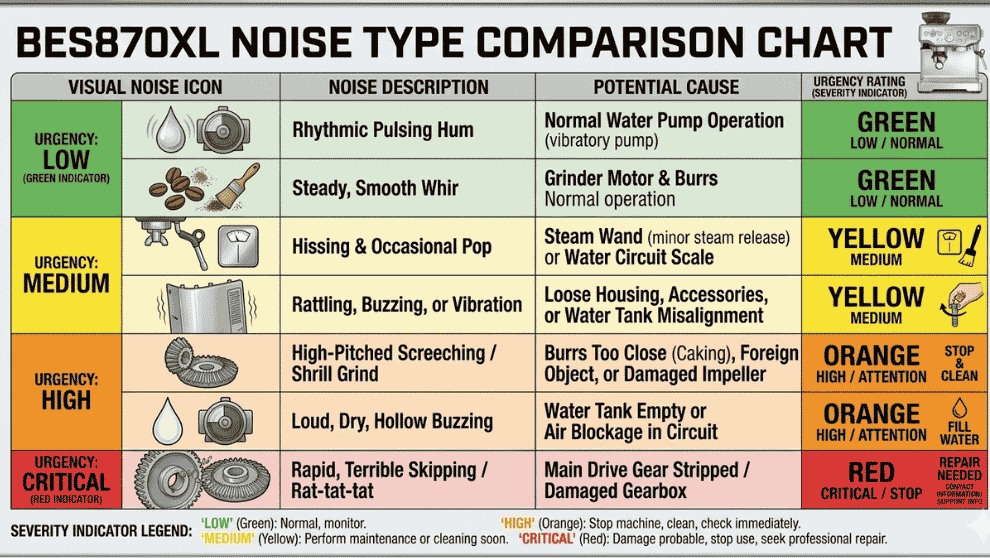
Noise Diagnostic Quick Reference
| Noise Type | Most Likely Cause | Urgency |
| Sharp crack or metallic impact | Foreign object in chamber | Stop immediately |
| Consistent rough / abrasive grind | Worn burrs | Replace burrs soon |
| Rhythmic metallic scraping | Burrs making contact | Coarsen grind setting |
| Irregular clicking (half-full hopper) | Bean bouncing in hopper | Normal; no action needed |
| Hollow rattling at coarse setting | Beans not drawing in | Adjust to espresso range |
| Buzzing or rattling during grinding | Loose component | Check tray, tank, hopper |
| Muffled, congested grinding | Chute blockage | Clean delivery chute |
| Continuous high-pitched whine | Motor bearing wear | Service or replace motor |
Understanding the noise profile of the BES870XL grinder and distinguishing between operational sounds and fault signals is a skill that develops with ownership. The key principle is that any sudden change in the grinder’s noise character warrants investigation before the next grinding session, not after.