

Water pressure is the mechanical foundation of espresso. The 9 bar extraction pressure that the BES870XL is designed to deliver is not a preference or a best-practice guideline it is the specific pressure at which espresso extraction chemistry occurs correctly, producing the emulsified oils, dissolved solids, and crema that characterize a properly extracted shot. When pressure falls below this range, the extraction fails in measurable and predictable ways: under-developed flavor, absent or minimal crema, watery body, and shots that run excessively fast regardless of how fine the grind is adjusted.
Low water pressure on the BES870XL can originate from five distinct points in the hydraulic circuit. Each has its own diagnostic signature, its own repair, and its own relationship to the machine’s other systems. Identifying the correct source before attempting repair saves both time and the cost of replacing functional components.
UNDERSTANDING THE BES870XL PRESSURE SYSTEM
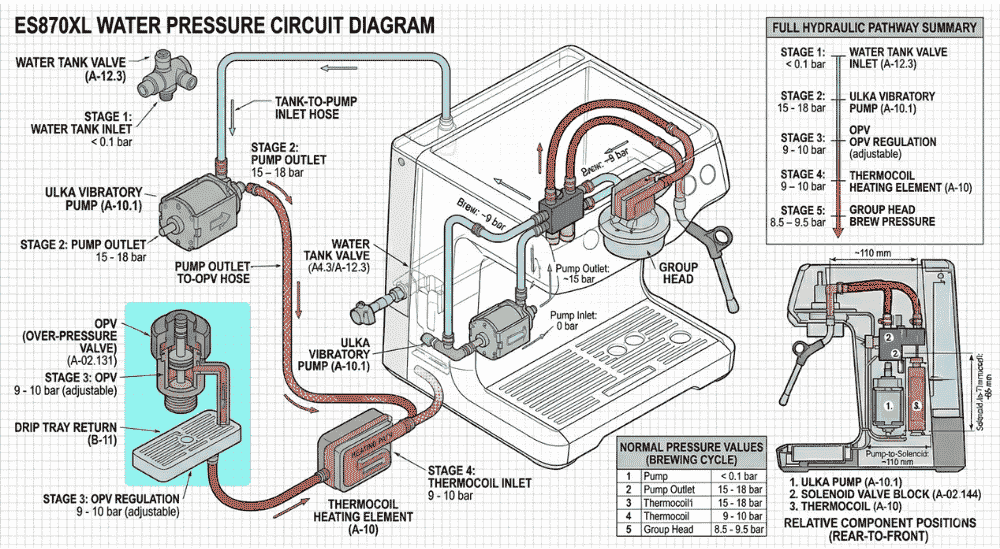
The pressure system on the BES870XL begins at the water tank and follows this path:
water tank → intake screen → pump inlet → vibratory pump → outlet check valve → solenoid valve → over-pressure valve (OPV) → thermocoil → group head → coffee puck → portafilter → espresso output.
The pump generates raw pressure, typically 12 to 15 bar. This excess pressure is not delivered to the coffee; instead, the over-pressure valve (OPV) bleeds off pressure above the set point (nominally 9 bar), returning the excess to the drip tray or water tank, depending on the machine configuration. The pressure the coffee actually experiences is therefore determined by both the pump’s output and the OPV’s set point.
A blockage or restriction anywhere in this circuit before the group head causes pressure to read low at the gauge and deliver low pressure at the coffee puck. Understanding which segment is causing the restriction is the central diagnostic challenge.
CAUSE 1: SCALE BUILDUP IN THE WATER CIRCUIT
Scale is the single most common cause of low pressure on the BES870XL and is responsible for the majority of reported pressure problems on machines that have been used for more than one year without regular descaling. Calcium and magnesium carbonates from the water supply precipitate on heated surfaces, primarily on the thermocoil interior and the group head screen, forming a progressively thickening mineral deposit that restricts water flow.
The pressure drop from scaling is gradual and often goes unnoticed until it has become severe. Owners who have not noticed a decline are typically surprised to see how dramatically pressure (and extraction quality) improves after a thorough descaling.
How to Identify Scale as the Cause:
The pressure gauge (if equipped) reads consistently in the lower range during extraction. Extraction times have been trending longer over months. The machine has not been descaled within the past three to six months. The water used is moderately to highly hard (above 100 ppm total dissolved solids).
The Fix:
Run a full descaling cycle using the BES870XL’s built-in descaling program with a citric acid-based or Breville-recommended descaling solution. One descaling cycle may not fully clear heavy scale accumulation if pressure does not return to normal after the first cycle. Run a second cycle after a 24-hour waiting period. For the correct descaling procedure, interval, and solution concentration for the BES870XL, follow the guide on How to descale Breville BES870XL properly.
CAUSE 2: PUMP WEAR OR PUMP FAILURE
The ULKA vibratory pump in the BES870XL has a finite service life. Under normal use (one to three shots daily), the pump piston seal and spring typically maintain full pressure for three to five years. Under heavy use, with hard water, or without regular descaling, pump wear accelerates. A worn pump produces less maximum pressure but does not fail completely; it degrades gradually, with the pressure shortfall becoming noticeable over a period of months.
How to Identify Pump Wear as the Cause:
The machine has been in service for three or more years. Pressure has declined gradually over time (not suddenly). Descaling has been performed, and pressure improved but did not fully return to normal. The pump sounds less forceful or slightly different in character than it used to (though this is subtle and requires familiarity with the machine’s baseline sound).
The Fix:
Pump replacement. A worn pump seal cannot be repaired at home; the piston assembly is not available as a discrete spare part, and attempting to repack the seal risks introducing contamination into the water circuit. For the complete pump replacement procedure, see the Breville BES870XL Water Pump Replacement Step-by-Step Repair Guide.
CAUSE 3: BLOCKED OR MALFUNCTIONING SOLENOID VALVE
The solenoid valve on the BES870XL is a three-way electromagnetic valve that controls water flow through the brew circuit. It opens to allow water from the pump to the group head during extraction, closes to stop flow when the brew cycle ends, and simultaneously opens a relief path to depressurize the puck (the characteristic “thud” sound at extraction end). If the solenoid valve is blocked by mineral scale or debris, or if its electromagnetic coil has failed, it may restrict flow even when energized, reducing the pressure delivered to the group head.
How to Identify a Solenoid Valve Problem:
The machine produces normal pump noise, but extraction pressure is low. The characteristic depressurization sound at the extraction end is absent, weak, or occurs at the wrong time. In some cases, the solenoid restricts flow to near-zero despite the pump running normally. A full solenoid valve diagnosis and replacement procedure is covered in the Breville BES870XL Solenoid Valve Replacement & Troubleshooting Guide.
The Fix:
Solenoid valve cleaning or replacement. A solenoid valve blocked by scale can sometimes be restored by soaking the valve body in descaling solution, but the BES870XL’s solenoid is not designed for easy removal, and the soaking approach requires partial disassembly. If cleaning does not restore normal function, valve replacement is required.
CAUSE 4: OVER-PRESSURE VALVE (OPV) MISCALIBRATION
The OPV is the pressure-limiting component that prevents the pump’s full output pressure from reaching the coffee. It is set at the factory to release at approximately 9 bar. Over time, the OPV spring can weaken, lowering the release point and causing pressure to bleed off prematurely, meaning the group head receives less than 9 bar even when the pump is producing normal output.
How to Identify OPV Miscalibration:
The pump sounds normal and produces normal noise levels. A flow meter test (if available) shows normal pump output volume. The pressure gauge reads lower than expected during extraction. The issue was not present before and appeared relatively suddenly, or appeared after the machine was dropped or subjected to physical impact.
The Fix:
OPV adjustment or replacement. Some BES870XL owners adjust the OPV set point by modifying the compression of the spring (by adding or removing shims, or by adjusting the set screw on adjustable OPV models). This modification requires a pressure gauge connection and careful incremental adjustment; it is not a procedure for first-time machine repair. A weakened spring that cannot be adjusted to the correct set point requires OPV replacement.
CAUSE 5: BLOCKED INTAKE SCREEN OR RESTRICTED WATER TANK CONNECTION
The water tank connects to the machine via a fitting that incorporates a fine mesh screen. This screen prevents particles from the tank (mineral deposits, debris from descaling solution) from entering the pump. When the screen becomes blocked, the pump starves for water and cannot generate full pressure regardless of its own mechanical condition.
How to Identify a Blocked Intake Screen:
Pressure is low. The pump sounds strained or cavitating (an irregular, hollow sound rather than a steady oscillation). The symptoms appear suddenly rather than gradually. The water tank was recently cleaned, descaled, or refilled with water that has visible particles or sediment.
The Fix:
Remove the water tank and locate the intake fitting on the machine chassis. The screen is typically accessible for cleaning with a small brush and warm water without disassembly. Remove visible debris and flush the fitting before refilling the tank and testing.
THE DIAGNOSTIC SEQUENCE: WORKING FROM SIMPLE TO COMPLEX
The optimal approach to low-pressure diagnosis on the BES870XL works through causes from least to most invasive:
Step 1 – Check when the machine was last descaled
If more than six months ago, or if the machine is in a hard water area and has never been descaled, perform descaling before any other diagnosis. This resolves the majority of low-pressure complaints.
Step 2 – Inspect the intake screen
Remove the water tank, inspect the intake fitting screen, and clean if necessary. This takes less than five minutes.
Step 3 – Check solenoid valve function
Listen for the characteristic depressurization sound and observe whether the extraction flow starts immediately when the pump begins or shows a delay. Delayed or absent flow suggests a solenoid issue.
Step 4 – Assess pump age and condition.
If the machine is more than three years old and has not had a pump service, and all other causes have been eliminated, the pump is the likely culprit.
Step 5 – Check OPV set point
If all other components test normally and pressure is consistently low (not variable), OPV spring weakening is the remaining likely cause.
LONG-TERM PRESSURE MAINTENANCE
The most effective pressure maintenance practice on the BES870XL is consistent descaling at the interval appropriate to the local water hardness. Hard water requires descaling every two to three months; soft water every six months. Using a water filter, either the Breville integrated filter or an external inline filter, significantly reduces scale formation rate and extends the intervals between descaling cycles, while simultaneously protecting the pump from mineral-laden water that accelerates piston seal wear.
A machine that receives consistent descaling and has its pump replaced at the four-to-five-year mark will maintain its original pressure performance indefinitely. The hydraulic system of the BES870XL is robust and long-lived when maintained correctly.