
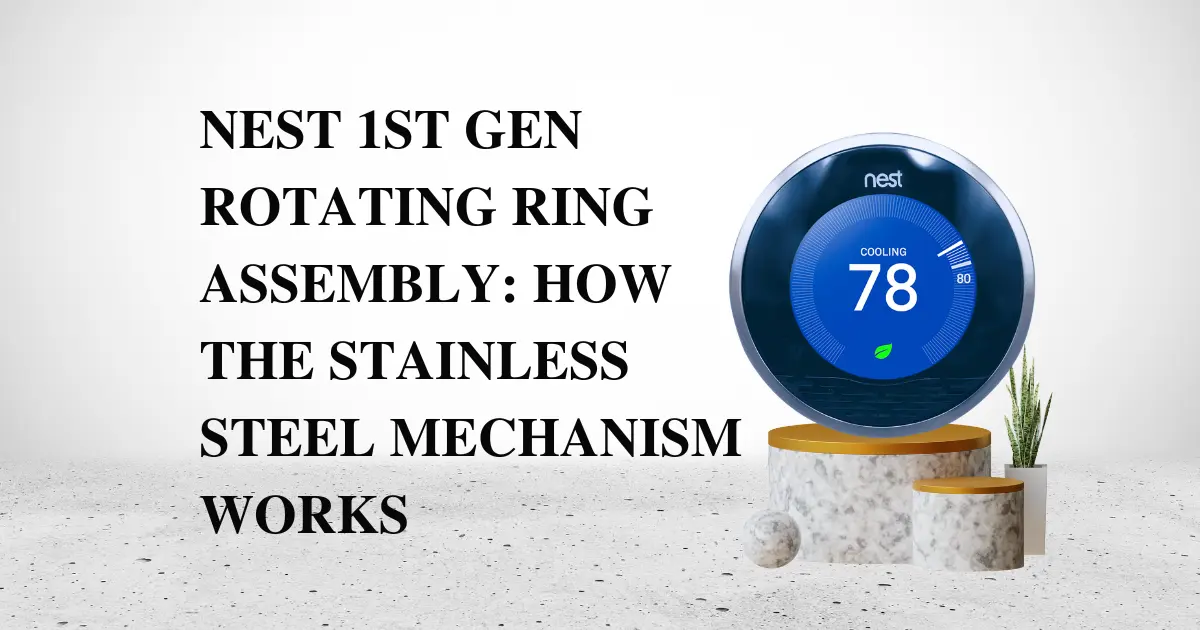
The stainless steel rotating ring on the Nest Learning Thermostat 1st Generation is simultaneously the device’s most distinctive visual element, its primary mechanical user interface, and one of the most precisely engineered components in the consumer thermostat category. When Tony Fadell’s team at Nest designed the first-generation thermostat, the rotating ring was the design decision that defined the product’s identity; it replaced the button arrays and touchpad interfaces of conventional thermostats with a single, highly tactile rotary control that communicates its function intuitively and provides a quality of mechanical interaction that users associate with premium products. Understanding how this ring works at the levels of materials, mechanics, electrical encoding, and control-system integration is the foundation for maintaining it properly and diagnosing the failure modes it can develop after years of service.
MATERIALS AND INDUSTRIAL DESIGN
The ring is machined from 316L stainless steel, a chromium-nickel-molybdenum alloy chosen for three specific properties:
Corrosion resistance
316L is marine-grade stainless steel with molybdenum addition that provides superior resistance to pitting corrosion compared to the more common 304-grade stainless. For a device mounted on a wall in living spaces subject to airborne moisture, cleaning products, and condensation during HVAC operation, long-term surface integrity was a design requirement.
Specific tactile mass
Stainless steel has a density approximately 3.5× higher than aluminum and dramatically higher than any plastic. At the Nest ring’s wall thickness and diameter, this density creates a rotational inertia that contributes to the distinctive “weighted” feel during rotation; the ring continues rotating slightly after the user releases it, in a manner no lightweight material can replicate.
Thermal conductivity
Stainless steel’s moderate thermal conductivity means the ring rapidly equilibrates to room temperature, providing a neutral-temperature surface feel rather than the cold-metal touch of aluminum or the warm-plastic feel of polymer construction.
The ring’s outer diameter matches the circular display housing precisely. The surface finish is a brushed circumferential finish applied by a belt or rotary polishing process that leaves concentric circular lines in the metal surface, visible under raking light. This finish serves an aesthetic function (conveying quality) and a functional one; the micro-texture improves tactile grip for the rotating action without requiring knurling or mechanical grip features that would alter the visual profile.
THE ROTARY ENCODER: TRANSLATING MECHANICAL MOTION TO DIGITAL INPUT
The ring’s rotation is translated into digital control signals through a rotary encoder mechanism. The Nest 1st Gen does not use a traditional detented rotary encoder (the click-per-step type common in consumer electronics knobs) as the primary encoding element. Instead, it uses a capacitive or resistive sensing approach along the ring’s inner circumference, combined with the encoder contacts, to determine both the direction and magnitude of rotation.
The encoding contact architecture:
On the inner circumference of the stainless steel ring, a set of conductive contact pads or wiper contacts interfaces with a corresponding contact track on the display housing. As the ring rotates, these contacts move across the track, generating a sequence of electrical signals that the logic board’s input processor interprets as clockwise or counterclockwise rotation of a specific angular increment.
The resolution of the encoder how many discrete steps are registered per full rotation determines the temperature adjustment granularity. The Nest 1st Gen registers single-degree Fahrenheit increments per step, meaning the encoder provides enough angular resolution for single-degree control with a comfortably large ring movement per step.
The ring also functions as a button: pressing the ring inward (the display moves slightly into the housing under finger pressure) activates a tactile switch beneath the display assembly. This press-to-confirm action is how menu selections are made: rotate to highlight, press to select.
THE DETENT MECHANISM: ENGINEERING THE TACTILE FEEL
One of the Nest ring’s most discussed characteristics among users and product reviewers is its precise detent feel the slight resistance and positive click at each rotation increment. This feel is engineered through a detent mechanism integrated between the ring and the display housing.
The detent mechanism consists of a spring-loaded ball or blade that rides in a series of depressions (detent positions) machined or molded into the inner ring surface or the housing track. As the ring rotates past each detent position:
1. The spring-loaded element rides up the ramp leading to the next detent
2. At the peak, a threshold force is required to proceed; this is the tactile resistance
3. The element snaps into the next detent; this is the audible and tactile click
The spring force, detent depth, and ramp angle are calibrated to produce approximately 30-50 grams of peak force at the ring surface for each step, firm enough to prevent accidental activation when brushing past the thermostat, light enough for comfortable intentional adjustment with minimal effort.
Over years of use, the detent mechanism experiences wear at three points: the spring-loaded element, the detent depressions, and the lubrication layer (a thin film of grease applied at manufacture) that reduces wear and provides consistent feel. As the grease migrates or degrades, the detent feel changes, often becoming either stiffer (as the dry metal surfaces create more friction) or less positive (as the detent depressions wear shallow). This wear progression is the primary mechanical cause of the ring feel complaints in high-usage 1st Gen units.
THE RING RETENTION MECHANISM
The ring is retained on the display housing by a clip mechanism: a set of plastic or metal tabs on the ring’s inner surface that engage with a corresponding groove or lip on the display housing exterior. This retention design:
- Holds the ring securely in normal use (no fasteners required)
- Allows the ring to rotate freely through its full travel range without disengaging
- Allows the ring to be removed by applying lateral outward force at the release point, for cleaning and servicing
The retention tabs are subject to stress whenever the ring is removed and reinstalled; each removal cycle applies a brief overload to the tab as it is forced past the retention lip. Over many cycles (or after a forced removal without finding the release point), retention tab fatigue can cause the ring to become loose in use, creating wobble and contact irregularities.
HOW THE RING INTERFACES WITH THE DISPLAY AND CONTROL LOGIC
The ring’s encoder signals are processed by the Nest 1st Gen’s main logic board, the same board that manages the display, Wi-Fi, sensor inputs, and HVAC control relays. The input processor on the logic board monitors the encoder contact signals at a high sampling rate (several hundred Hz) and converts the contact sequence into rotation direction and step count.
The firmware maps these rotation steps to interface actions:
- On the home screen: rotation adjusts the target temperature setpoint
- In menus: rotation scrolls between options
- During away/home transitions: rotation confirms the mode change
The ring input is treated as the highest-priority input source on the logic board; ring rotation immediately interrupts any background processing to update the display, ensuring zero perceptible latency between ring movement and display response. This is the design basis for the Nest’s subjectively “responsive” feel.
RING MAINTENANCE: KEEPING THE MECHANISM IN OPTIMAL CONDITION
The primary maintenance requirement for the ring assembly is periodic cleaning of the encoder contacts and the housing track surface. Airborne dust, pet hair, and skin oils accumulate in the interface gap between the ring and the housing over years of use. This accumulation:
- Increases friction in the rotation pathway
- Interferes with encoder contact continuity, causing missed steps or erratic behavior
- Traps moisture that can oxidize the contact surfaces
Cleaning procedure
Rotate the ring to various positions and use a soft, slightly damp cloth to wipe the accessible outer surface. For the inner interface gap, compressed air directed into the gap at multiple ring positions dislodges accumulated debris. Do not introduce liquid into the interface gap; the encoder contacts require dry contact operation.
The detailed diagnosis and repair of clicking, sticking, and erratic ring behavior caused by accumulated debris and wear is covered in the companion guide How to Fix a Clicking or Stuck Rotating Ring on Nest 1st Generation.