
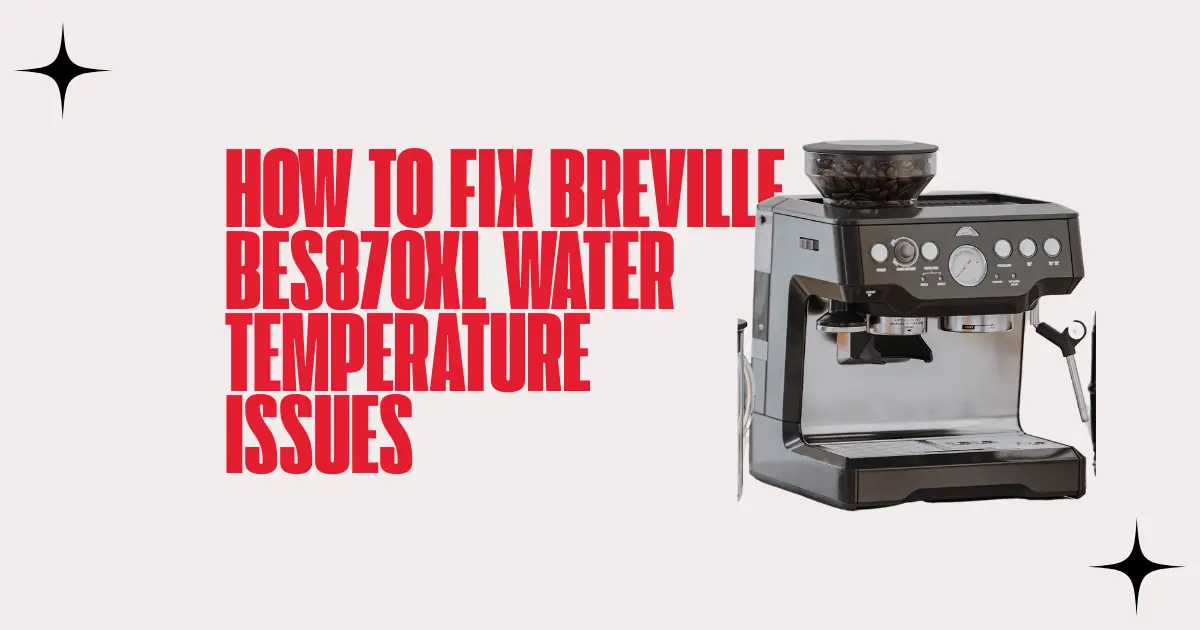
Water temperature inconsistency on the Breville BES870XL Barista Express is one of the most damaging performance problems an espresso machine can develop because it is invisible. A machine that pumps at the wrong pressure announces the problem through the pressure gauge. A machine with a clogged grinder makes audible noise. But a machine that delivers water at 185°F instead of the ideal 200°F (93°C) produces shots that taste sour or weak without any obvious mechanical indicator. The espresso looks normal, the timing looks normal, the pressure looks normal, but the extraction is fundamentally broken because the thermal foundation it depends on is wrong.
Temperature inconsistency on the BES870XL manifests in two distinct ways: shots that are consistently under-temperature (always too cool), and shots that vary between pulls, sometimes correct, sometimes off. Both have specific causes, and both have specific fixes. Understanding the difference between them is the starting point for every accurate diagnosis.
HOW THE BES870XL MANAGES BREW WATER TEMPERATURE
The BES870XL uses a thermocoil (a coiled stainless steel tube) as its primary heat exchanger. Cold water from the tank enters the thermocoil at one end, travels through the coil while being heated by the surrounding element, and exits at extraction temperature directly into the group head. This design produces water at the correct extraction temperature on demand without maintaining a large volume of water at temperature between shots.
The thermocoil’s output temperature is regulated by
The thermostat: a bimetallic disc switch that cycles the heating element on and off to maintain the thermocoil at its set operating temperature
The thermosensor (NTC thermistor): a temperature-sensitive resistor that provides the control board with real-time temperature data, allowing the board to make fine adjustments to element cycling
The element itself: the resistive heating wire that surrounds the thermocoil and transfers heat to the water
Each of these components can be the source of temperature inconsistency, and each produces a different symptom pattern.
CAUSE 1: MINERAL SCALE ON THE THERMOCOIL INTERIOR
Mineral scale is the most common cause of consistently low extraction temperature on the BES870XL. Calcium carbonate deposits accumulate on the thermocoil’s inner walls with every brew cycle, progressively reducing the heat transfer between the surrounding element and the water flowing through the tube.
The mechanism
Heat transfers from the element to the thermocoil’s metal walls, then from the walls to the water inside. A mineral scale layer on the inner wall is a thermal insulator; it has far lower thermal conductivity than stainless steel. As scale builds, the water flowing through the thermocoil exits at progressively lower temperatures because the insulating scale layer prevents efficient heat transfer to the water.
Symptoms
Consistently under-temperature shots across all brew sessions. Shots take longer to pull than before (lower water temperature reduces extraction speed). Sour taste in espresso from under-extraction. The symptom is stable; it does not vary shot to shot but is consistently worse than it was months ago.
The fix: Descaling
Removing the mineral scale layer from the thermocoil’s interior restores heat transfer efficiency and brings extraction temperature back to specification. For a complete step-by-step descaling procedure specifically for the BES870XL, see How to Descale Breville BES870XL Properly.
CAUSE 2: THERMOSTAT FAILURE
The thermostat in the BES870XL is a bimetallic disc that controls when the heating element cycles on and off. It is calibrated to a specific temperature range; it opens (cuts power to the element) when the thermocoil reaches the upper limit, and closes (restores power) when it drops to the lower limit. This cycling maintains the thermocoil temperature in a narrow range around the target setpoint. When the thermostat fails:
Thermostat stuck open (element never activates)
The thermocoil never reaches operating temperature. The machine never completes its heat-up cycle or produces extremely cold water at the group head. The symptom is complete, not intermittent.
Thermostat calibration drift (setpoint has shifted lower)
The thermostat opens and closes at temperatures below its original calibration; the element cycles correctly but around a lower temperature than intended. Water exits the thermocoil slightly below extraction temperature on every brew. This is more subtle and is often confused with scale-related temperature loss.
Thermostat with intermittent contact failure
The thermostat’s bimetallic element makes intermittent contact, sometimes cycling correctly, sometimes failing to complete the circuit. This produces variable temperature behavior: some shots extract at the correct temperature when the thermostat happens to be in correct contact, and others are noticeably under-temperature when it loses contact.
Diagnosis
A thermostat calibration fault or intermittent contact can be confirmed by measuring the thermocoil’s surface temperature with an infrared thermometer after the ready indicator illuminates. A correctly functioning BES870XL should read approximately 200–205°F at the group head face at ready state. A consistently low reading after full warm-up (15 minutes from cold) points to a thermostat or thermosensor fault.
CAUSE 3: THERMOSENSOR (NTC THERMISTOR) FAULT
The thermosensor provides the control board with a continuously variable resistance signal that corresponds to the current thermocoil temperature. The board uses this signal to optimize element cycling beyond what the simple on/off thermostat provides. A thermosensor that has drifted in its resistance-temperature relationship or one that has failed to a fixed resistance value causes the control board to misread the actual thermocoil temperature and apply incorrect heating correction.
Symptoms
Temperature inconsistency that varies between brew sessions, sometimes correct, sometimes off, without any pattern related to time of day or number of shots pulled. The machine appears to heat up normally (the ready indicator functions correctly), but extraction temperature is variable.
Testing
A thermistor can be tested with a multimeter by measuring its resistance at a known temperature. NTC thermistors decrease in resistance as temperature increases; a specific resistance value corresponds to each temperature on the thermistor’s characteristic curve. At room temperature (25°C / 77°F), a typical espresso machine thermistor reads approximately 10–50 kΩ depending on the specific component. Comparing this reading against the manufacturer’s specification for that temperature confirms whether the sensor has drifted.
CAUSE 4: INSUFFICIENT MACHINE WARM-UP TIME
A frequently overlooked cause of consistently under-temperature extraction on the BES870XL is insufficient warm-up time before brewing. The BES870XL’s ready indicator typically illuminates after approximately 25-30 seconds, but this signals that the thermocoil has reached temperature, not that the group head’s thermal mass has reached temperature. The group head is a large aluminum casting that requires 8–15 minutes of sustained operating temperature to fully warm through from cold.
If shots are pulled within the first 2–3 minutes of the ready indicator appearing, the cold group head absorbs a significant amount of heat from the brew water as it passes through, lowering the effective temperature at the puck by several degrees. This is not a fault; it is a thermal mass reality that all espresso machines with aluminum group heads share.
Fix
Allow a minimum 15-minute warm-up from cold before pulling the first shot. Use the pre-infusion to accelerate group head warm-up: run 20-30 seconds of hot water through the group head (portafilter removed) before pulling the first shot. This flushes the cold water held in the group head and brings the metal to operating temperature faster.
CAUSE 5: THERMOCOIL DAMAGE FROM SCALE ACCUMULATION
In machines that have operated for extended periods without descaling, mineral scale deposits can become severe enough to cause localized overheating of the thermocoil tube walls — the scale insulates the inner surface from the water, causing the metal wall itself to reach temperatures significantly above the water inside it. This thermal stress can cause the thermocoil tube to crack or develop pinholes. A damaged thermocoil produces erratic temperature output, sometimes normal, sometimes dramatically off, and is accompanied by possible internal water leakage.
Diagnosis:
If descaling does not fully restore consistent temperature, and if the machine shows any signs of internal moisture (water pooling in the drip tray without a corresponding visible external leak), the thermocoil may be physically damaged. The detailed thermocoil assessment and repair procedure is covered in the Breville BES870XL Thermocoil Repair Guide (DIY Fix).
DIAGNOSING TEMPERATURE INCONSISTENCY: THE CORRECT SEQUENCE
Step 1 – Confirm adequate warm-up time (15+ minutes from cold). Pull a shot and evaluate extraction time and taste.
Step 2 – If the problem persists, perform a complete descaling cycle. Allow three brew cycles after descaling before evaluating.
Step 3 – If temperature is still low or variable after descaling: measure group head temperature with an infrared thermometer at ready state.
Step 4 – If group head temperature is consistently below 195°F: thermostat calibration or thermosensor fault. Test thermostat continuity and thermosensor resistance.
Step 5 – If temperature varies unpredictably: thermosensor fault or thermocoil damage.
Step 6 – If descaling, the thermostat, and the thermosensor are all confirmed normal, but the temperature is still low: evaluate the thermocoil’s physical condition per the thermocoil repair guide.