

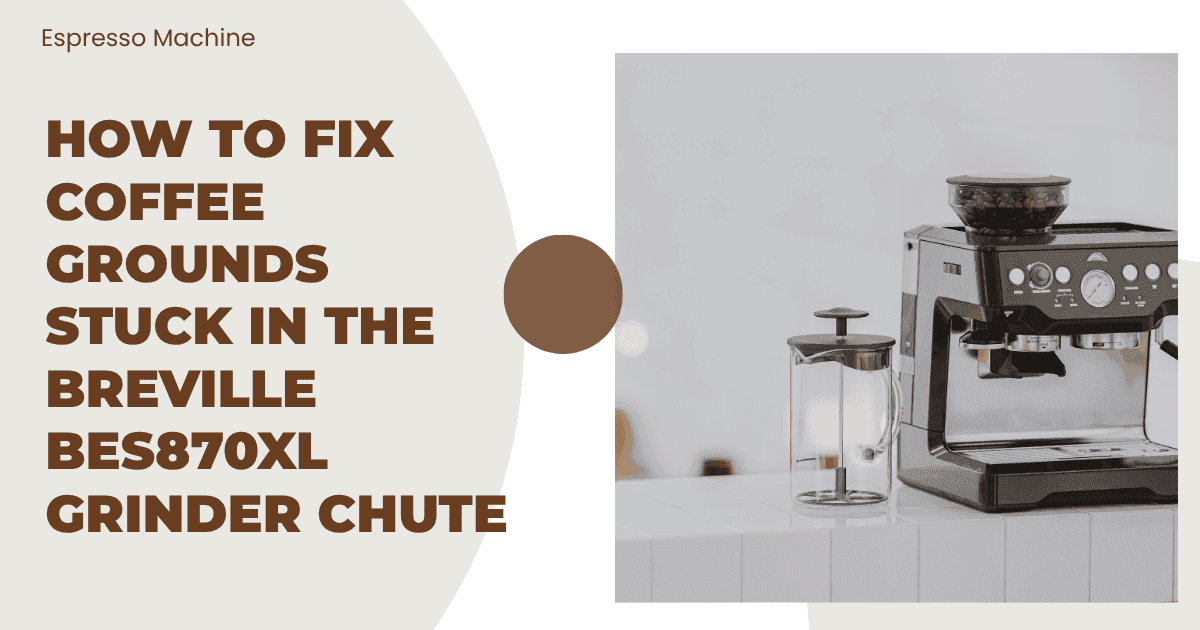
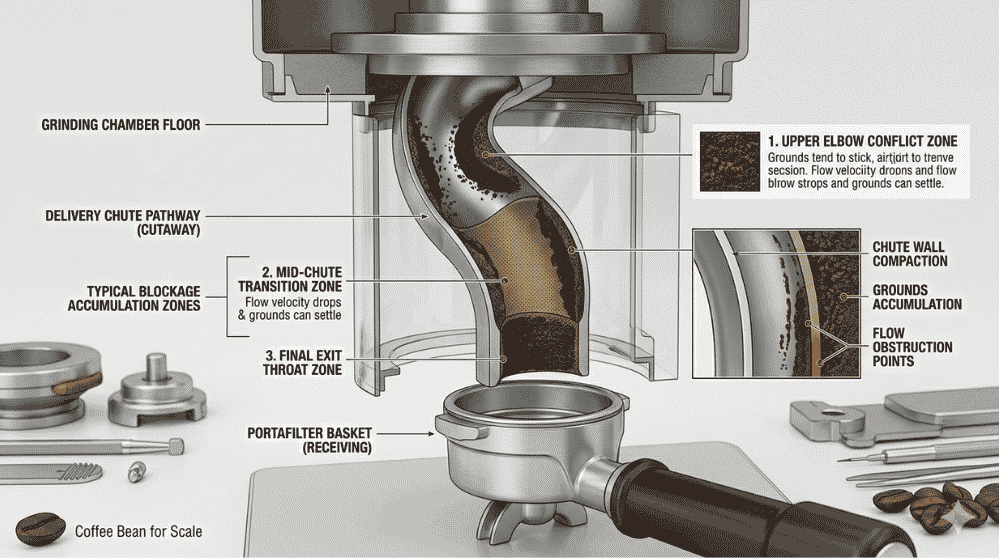
The delivery chute on the Breville BES870XL is the narrow passage that bridges the grinding chamber and the portafilter basket. It is one of the most functionally critical and most frequently neglected components in the machine. When this chute becomes partially or fully blocked, the symptoms are easily misread: the grinder appears to be running normally, the dose weight comes up short, extraction times run long, or the shot barely flows, and the user adjusts grind settings in the wrong direction making a blocked chute progressively worse.
Understanding what causes the BES870XL delivery chute to clog, how to distinguish a chute blockage from other grinder problems, and how to clear and prevent blockages is essential knowledge for anyone who uses this machine regularly.
WHY THE BES870XL DELIVERY CHUTE BLOCKS
The delivery chute is a narrow rectangular or oval passage, typically 8 to 12 millimeters in its narrowest dimension, through which ground coffee must flow from the grinding chamber into the portafilter basket below. Several physical and chemical mechanisms cause this passage to clog.
Coffee Oil Polymerization
Every batch of coffee grounds that passes through the chute deposits a thin film of coffee oil on the chute walls. At room temperature, these oils polymerize over time, transitioning from a liquid film into a sticky, tar-like residue. This residue acts as a binding agent for subsequent grounds, causing them to adhere to the chute walls rather than fall freely into the basket. Over days and weeks without cleaning, the adhered layer grows inward until the effective chute diameter is significantly reduced.
Fine Particle Accumulation
Espresso grind produces a significant population of very fine particles, sub-100 micron material sometimes called “dust fines.” These particles have high surface area and adhere strongly to oily surfaces. In a partially polymerized chute, dust fines accelerate blockage formation dramatically, filling in the spaces between larger adhered grounds.
Static Electricity Buildup
Static charge accumulation is a known phenomenon in conical burr grinders, particularly in low-humidity environments. Statistically charged grounds repel each other in the air but attract powerfully to the grounded metal surfaces of the chute. In dry climates or winter months with low indoor humidity, static-driven chute adhesion can clog a well-maintained chute within a single grinding session.
Compaction from Over-Grinding
If the grinder runs past the point where the portafilter basket is full, either because the grind amount setting is too high or because grounds are not flowing freely, grounds begin to compact back into the chute from below. This compaction creates a dense plug that is mechanically distinct from oil-adhesion blockage and requires different clearing techniques.
IDENTIFYING A CHUTE BLOCKAGE VERSUS OTHER PROBLEMS
Before clearing a suspected chute blockage, it helps to confirm that the chute is the source of the problem rather than the grinder burrs, the grinder motor, or the grind settings.
Symptom Pattern of a Chute Blockage:
The grinder runs for the full programmed duration and sounds normal. Grounds output is significantly less than the expected dose weight. Extraction time is abnormally long (if any flow occurs at all). The portafilter basket may be under-dosed despite the grinder completing its cycle. The deficit worsens progressively over multiple shots.
How It Differs from a Motor or Jam Problem:
A motor failure or burr jam produces no output at all; the grinder either does not run or runs and produces no sound of beans being processed. A chute blockage allows the grinder to complete its cycle normally; the problem is in the downstream passage, not the grinding mechanism itself. For comparison, the full diagnostic process for grinder failures is described in the guide on How to Fix Breville BES870XL Grinder Not Working.
How It Differs from a Grind Setting Problem:
An incorrect grind setting affects extraction flow rate but does not affect dose weight. If the grinder completes its cycle and the basket appears to have less coffee than expected, the issue is delivery, not grinding. A grind setting that is too fine will produce a normal dose weight but very slow (or absent) flow; a chute blockage produces both reduced dose weight and abnormal flow simultaneously.
CLEARING A PARTIAL CHUTE BLOCKAGE
A partial blockage, one where some grounds are still passing through but in reduced quantity, can often be cleared without disassembly using the following procedure.
Step 1 – Probe the Chute Externally
With the machine unplugged, look into the delivery chute from the portafilter cradle side. In most cases, the chute is visible as an opening above the portafilter basket position. Use a wooden skewer, toothpick, or pipe cleaner to probe the chute from below and break up any visible accumulation. Work gently; the goal is to dislodge adhered grounds, not to push the blockage deeper.
Step 2 – Brush from Above
Remove the bean hopper and look down through the grinding chamber to the chute outlet at the chamber floor. Use the included cleaning brush to work grounds material toward and through the chute opening. If the grinder has recently been run, residual loose grounds in the chamber will assist in flushing the chute when the grinder is next operated.
Step 3 – Run a Clearing Grind Cycle
With the hopper removed but with a small amount (10 to 15 grams) of coffee beans placed directly into the grinding chamber, run the grinder on manual mode. The vibration of the grinding cycle, combined with the flow of fresh grounds, often dislodges partially adhered material and carries it through the chute.
Step 4 – Inspect and Test
After the clearing cycle, inspect the portafilter basket. If dose weight has returned to normal (typically 18 to 22 grams depending on basket size and settings), the blockage has cleared. Pull a test shot and observe the extraction time to confirm the chute is flowing freely.
CLEARING A FULL CHUTE BLOCKAGE
A full blockage where no grounds are reaching the portafilter basket despite the grinder running requires more direct intervention and typically involves partial disassembly.
Step 1 – Identify the Blockage Location
Full blockages on the BES870XL can occur at three locations: at the chute outlet where it enters the grinding chamber floor, within the chute passage itself, or at the chute’s exit into the portafilter dosing area. Identifying the location determines the most effective clearing approach.
Probe both ends of the chute with a wooden skewer. If the skewer encounters resistance immediately when inserted from the portafilter side, the blockage is at the lower exit. If the skewer passes freely from below but encounters resistance when probed from above (through the grinding chamber), the blockage is at the upper inlet. If there is resistance throughout, the entire chute is packed.
Step 2 – Hot Water Flush (Lower Blockage)
For a blockage at the chute exit into the portafilter area, a targeted hot water flush can soften the polymerized oil binding the grounds together. Using a small squeeze bottle or a syringe, introduce approximately 5 ml of hot (not boiling) water directly into the chute opening from the portafilter side. Allow it to sit for two minutes to soften the oil residue, then probe again with a wooden skewer. The combination of softened oil and mechanical disruption will usually dislodge the blockage.
Important: Direct water only at the chute passage itself; do not allow water to flow into the grinding chamber or onto the burr surfaces, as moisture on the burrs can cause grounds to cake and harden.
Step 3 – Upper Burr Removal for Upper-Inlet Blockage
If the blockage is at the chute inlet on the grinding chamber floor, direct access from above is required. Remove the bean hopper, then remove the upper burr carrier (counterclockwise rotation to release the bayonet lock). With the upper burr removed, the grinding chamber floor and the chute inlet are fully accessible. Use a stiff brush and compressed air to clear the inlet thoroughly.
Step 4 – Reassemble and Test
Reinstall the upper burr carrier, confirming the bayonet lock engages correctly. Run a 15-gram clearing grind cycle with beans placed directly in the chamber. Verify dose weight and extraction time before returning to normal operation.
STATIC-DRIVEN CHUTE CLOGGING: THE HUMIDITY FACTOR
Static-driven chute clogging behaves differently from oil-adhesion blockage and requires a different response. The symptom is grounds spraying or clustering erratically during dosing, with grounds adhering to the chute walls and the portafilter basket rim rather than falling cleanly into the basket. This behavior is particularly pronounced on cold, dry winter days and when grinding light-roasted beans (which have lower surface oil content and thus build more static charge).
Solutions for static-driven chute adhesion:
The Ross Droplet Technique (RDT): Add a single drop of water to the bean hopper before grinding. The moisture absorbed by the beans dramatically reduces static generation during grinding. Use a finger dipped in water to deposit a droplet; the quantity is minimal enough that it does not affect grind performance or moisture content meaningfully.
Increasing Ambient Humidity: During dry winter months, operating a humidifier in the room where the machine is used reduces static accumulation in the grinder. While not a direct fix, it significantly reduces the frequency of static-driven blockages.
Grounding the Chute: Some users attach a copper or aluminum grounding strip to the chute exterior, connected to the machine chassis. This provides a path for static charge to dissipate without building up on the chute walls. This is a modification and should only be attempted by users comfortable with basic electrical principles.
PREVENTING CHUTE BLOCKAGE: THE MAINTENANCE PROTOCOL
The most effective approach to chute blockage is prevention through a consistent cleaning protocol. The following schedule maintains a clear chute on the BES870XL:
After Every Session: Use the cleaning brush to sweep the visible grinding chamber floor and the chute inlet. This removes loose grounds before they can adhere.
Weekly: Probe the delivery chute from below with a wooden skewer or pipe cleaner as part of the standard cleaning session. Run a grinder cleaning tablet cycle, which deposits a dry cleaning agent that absorbs oils from the chute walls as it passes through.
Monthly: During the full burr removal cleaning described in the guide on How to Clean Breville BES870XL Burr Grinder Properly, use compressed air to blow through the chute from both directions, and inspect the chute walls under bright light for oil film accumulation. A thin brown coating is normal; a thick, sticky, dark layer indicates the cleaning frequency needs to be increased.
The relationship between chute cleanliness and overall machine performance is direct and measurable. A clear, clean chute delivers consistent dose weights, which is a prerequisite for consistent extraction. No amount of dialing-in technique compensates for a delivery system that deposits variable amounts of coffee into the basket from one shot to the next.