
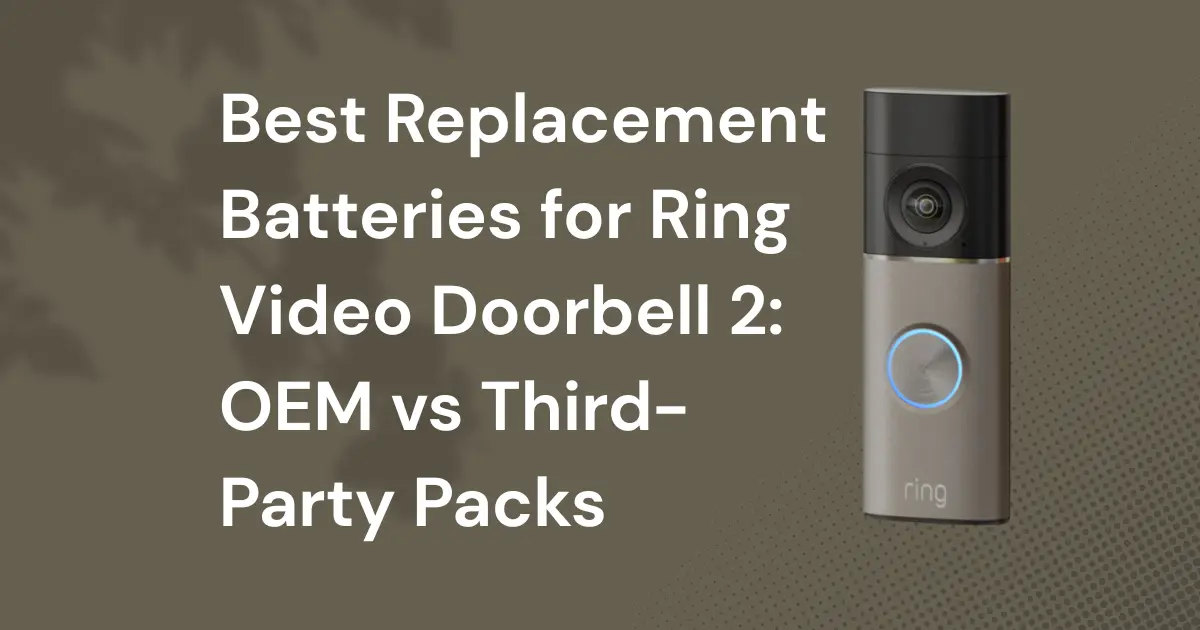
The Ring Video Doorbell 2’s quick-release battery pack is a lithium-ion consumable; it has a finite number of charge cycles before its capacity degrades to the point where replacement is necessary. When that point arrives, the owner faces a purchasing decision that the battery market has made genuinely complex: the OEM Ring Quick Release Battery Pack sits alongside dozens of third-party alternatives on major retail platforms, many of which claim full compatibility but vary significantly in actual capacity, safety certifications, and long-term reliability. Making the right choice requires understanding what the battery specification actually means for the Ring Video Doorbell 2, what third-party manufacturers typically compromise on, and which quality indicators reliably distinguish good alternatives from problematic ones.
THE OEM RING QUICK RELEASE BATTERY PACK: WHAT YOU ARE PAYING FOR
Ring’s official replacement battery sold as the “Ring Quick Release Battery Pack” is the baseline against which all alternatives should be evaluated. It is available from Ring’s website, Amazon (fulfilled by Ring), and major electronics retailers.
Official OEM specifications:
Capacity: 6,040 mAh at 3.3V nominal (approximately 19.9 Wh)
Chemistry: Lithium-ion
Charging interface: Micro-B USB port on battery body
Charging voltage: 5V via USB (standard)
BMS (Battery Management System): Integrated, manages charge cutoff, over-discharge protection, temperature monitoring, and cell balancing
Physical form: Proprietary Ring form factor with specific contact geometry
What the OEM price includes
Ring-certified contact geometry: The electrical contacts on the OEM battery are machined to Ring’s exact specification, ensuring reliable contact with the Ring Video Doorbell 2’s battery bay contacts across thousands of insertion cycles. Poor-quality contacts on third-party batteries cause voltage sag under load, inconsistent charging, and “battery not detected” errors.
Certified BMS: The OEM battery’s BMS is validated against the Ring Video Doorbell 2’s charging circuit. It correctly communicates state-of-charge data to the device (which feeds the battery percentage display in the Ring app). Third-party batteries with inadequate BMS communication may display incorrect battery percentages or cause the device to misreport the charge state.
UL certification: The OEM battery carries UL 2054 certification (the standard for household and commercial batteries in the US), confirming that the battery has been independently tested for safety, resistance to overcharge, over-discharge, short circuit, vibration, and temperature extremes.
Genuine capacity: The advertised 6,040 mAh is the actual measured capacity at the nominal discharge rate under controlled conditions.
OEM price range: $20–$30 USD (Ring website and Amazon).
THE THIRD-PARTY BATTERY MARKET: THE QUALITY SPECTRUM
Third-party replacement batteries for the Ring Video Doorbell 2 range from genuine high-quality alternatives that match or approach OEM performance, to low-quality counterfeits that claim inflated capacities and lack basic safety certifications. The price range for third-party alternatives is typically $10-$22 USD.
What legitimate third-party batteries provide
Dimensional compatibility: The battery’s form factor must match Ring’s quick-release bay precisely. Length, width, and height tolerances must be within the bay’s acceptance range, and the contact geometry must mate correctly with the device contacts.
Adequate BMS: A functional BMS that prevents overcharge and over-discharge protects both the battery and the Ring device. Without BMS protection, a charging fault can cause thermal runaway, a lithium-ion safety failure that can result in fire.
Honest capacity rating: Legitimate third-party manufacturers rate capacity at the same discharge conditions as OEM (0.2C rate at 25°C). A battery claiming 6,500 mAh or 7,000 mAh while being sold at a lower price than the OEM 6,040 mAh pack is almost certainly overstating actual capacity.
Comparable Ring app compatibility: The battery communicates state-of-charge to the Ring device through a simple voltage-to-percentage mapping. Third-party batteries using the correct contact interface and voltage characteristics will display correct or near-correct charge percentages in the Ring app.
What low-quality third-party batteries commonly compromise
1. Capacity inflation: The most pervasive problem in the third-party battery market. A battery labeled “6,500 mAh” or “7,200 mAh” that is priced below the OEM battery almost certainly contains cells with significantly lower actual capacity. Discharge testing of budget Ring-compatible batteries by independent reviewers has found actual capacities 20–50% below the label claim in many cases.
2. BMS absence or inadequacy: Some budget alternatives omit a proper BMS entirely or include a minimal protection circuit that handles only basic short-circuit protection without temperature monitoring, cell balancing, or communication with the host device. An unprotected lithium-ion battery charged in a wall-mounted device without thermal monitoring is a fire risk.
3. Contact quality: Budget batteries use stamped steel contacts with thin gold or nickel plating that wears through after 50–100 insertion cycles. Contact resistance increases as the plating wears, causing charging inefficiency and eventually causing the device to fail to detect the battery.
4. Cycle life: OEM lithium-ion cells in the Ring battery retain approximately 80% capacity after 300-500 charge cycles. Budget cells using lower-grade cathode materials may reach 70% capacity degradation after 100–150 cycles.
HOW TO EVALUATE A THIRD-PARTY BATTERY: THE FIVE QUALITY INDICATORS
For buyers who choose a third-party alternative, the following five indicators reliably separate quality alternatives from problematic ones:
Indicator 1 – UL, CE, or FCC certification marking
A lithium-ion battery sold in the United States should carry UL 2054 certification (for the battery cells) and/or CE marking (for European market compliance). These marks indicate independent safety testing. A battery with no certification markings or only brand-invented safety logos has not been independently tested.
Indicator 2 – Weight
Lithium-ion cells have a consistent energy density of approximately 150-250 Wh/kg depending on chemistry. A Ring-compatible battery claiming 6,000 mAh should weigh approximately 120-140 grams for the battery cells alone, plus the casing and contacts. A battery that weighs significantly less than this range contains cells with lower than claimed energy content. Weigh any received battery with a kitchen scale and compare against the OEM weight (approximately 370g total including packaging, approximately 100–120g for the battery pack alone).
Indicator 3 – Accurate Ring app battery percentage display
After installation, a quality third-party battery will display a battery percentage in the Ring app that accurately reflects the charge state. A battery that always shows 100% regardless of use, or jumps from high percentages to zero unexpectedly, has a BMS that does not communicate correctly with the Ring device, indicating a low-quality or incompatible control circuit.
Indicator 4 – Seller reputation and review history
On Amazon, filter reviews by date (most recent first) and read for specific mentions of: battery capacity after 3–6 months of use, Ring app compatibility, and physical fit quality. Generic reviews that focus only on the delivery experience are not informative. Look for reviews from users who have used the battery for 3 months or more.
Indicator 5 – Reasonable capacity claims
Be skeptical of capacity claims above 6,500 mAh for a battery at this form factor and price point. The Ring OEM battery uses high-quality cells to achieve 6,040 mAh in its constrained form factor; a budget alternative claiming 20-30% more capacity in the same physical size using lower-cost cells is making a physically implausible claim.
THIRD-PARTY BATTERIES AND RING WARRANTY
Using a non-Ring battery in the Ring Video Doorbell 2 does not void the device’s warranty under US warranty law (the Magnuson-Moss Warranty Act prohibits manufacturers from voiding warranties for using compatible third-party components). However, if a third-party battery causes physical damage to the device, contact corrosion, or charging circuit damage from an unprotected battery’s overvoltage event, Ring may attribute the damage to the non-OEM battery and decline warranty service for the device damage.
The practical risk management
If the Ring Video Doorbell 2 is within its warranty period, the risk of a third-party battery causing warranty-relevant device damage (however low with a quality third-party alternative) makes the OEM battery the more conservative choice. For out-of-warranty devices, the risk calculus shifts toward the cost savings of a vetted third-party alternative.
BATTERY PERFORMANCE IN COLD WEATHER: AN OEM ADVANTAGE
Lithium-ion battery performance in cold temperatures is a significant issue for outdoor security devices. As ambient temperature drops below 0°C (32°F), lithium-ion cells experience increased internal resistance and reduced available capacity. A Ring Video Doorbell 2 battery that delivers 6 months of battery life in summer may deliver only 1-3 months in winter in cold climates.
OEM batteries use cells with better low-temperature performance than budget alternatives because of higher-quality electrolyte formulations. Users in cold climates where winter temperatures regularly fall below 20°F (−7°C) will see a more pronounced difference between OEM and budget battery performance in winter than in summer. The detailed causes and solutions for cold-weather battery drain are covered in the companion guide How to Fix a Ring Doorbell 2 That Won’t Hold a Charge in Cold Weather.
THE CHARGING BOARD AND CONTACT INTERFACE: HOW BATTERY QUALITY AFFECTS DEVICE LONGEVITY
The Ring Video Doorbell 2’s charging circuit the board inside the device that manages the charging current to the battery is designed to operate with a battery presenting a specific impedance profile and BMS communication protocol. A low-quality battery with high internal resistance causes the charging circuit to work harder, generating more heat in the charging board components. Over time, repeated charging cycles with a high-impedance battery can stress the charging board’s FETs and protection components.
This is not a theoretical concern; it is the mechanism by which a cheap battery can cause device-level damage over a multi-year ownership period. The charging board is a repairable component, but its repair requires device disassembly and SMD soldering. The relationship between battery quality and charging board health is part of the broader component context examined in the companion guide How to Replace the Charging Port, Charging Board, and Battery Contacts in Ring Doorbell 2.
RECOMMENDATION SUMMARY
For owners within Ring’s warranty period or who prioritize long-term device health: OEM Ring Quick Release Battery Pack is the unambiguous choice for safety certification, accurate app reporting, and guaranteed compatibility.
For out-of-warranty owners seeking cost savings: A third-party battery from a reputable seller with UL/CE certification, realistic capacity claims (5,500–6,200 mAh), verifiable positive long-term reviews, and a weight consistent with its stated capacity. Avoid batteries with capacity claims above 6,500 mAh at budget pricing; these are virtually always overstated.