
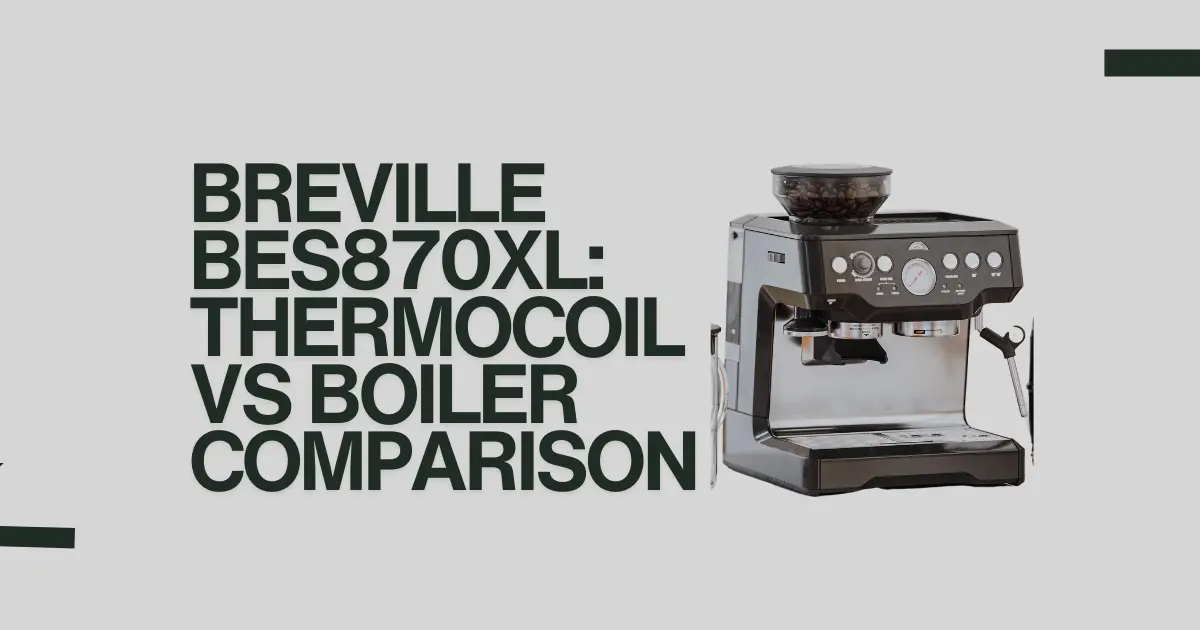
The question of thermocoil versus boiler is not simply a matter of preference; it is a fundamental architectural difference in how an espresso machine manages water temperature, thermal mass, and energy delivery. The Breville BES870XL uses a thermocoil (also called a thermoblock) system, while most traditional and high-end espresso machines use a boiler. These are not interchangeable approaches that happen to produce the same result through different means. They represent genuinely different engineering philosophies, each with distinct performance characteristics, failure patterns, maintenance requirements, and implications for espresso quality.
This comparison is written for BES870XL owners who want to understand why their machine behaves the way it does, why it heats so quickly, why temperature can vary between shots, why scale affects it differently than it affects a boiler machine, and for those considering whether the BES870XL’s thermocoil architecture is the right long-term platform for their needs.
THE ENGINEERING ARCHITECTURE: WHAT EACH SYSTEM ACTUALLY IS
The Thermocoil (Thermoblock) System
A thermocoil heats water on demand by flowing it through a narrow tube that is in direct contact with a resistive heating element. In the BES870XL, cold water enters the thermocoil from the pump, travels the length of the coiled tube while the element heats the tube walls, and exits at brew temperature directly to the group head. The entire water volume that is heated at any given moment is the small amount contained within the tube, typically 30 to 60ml.
The heating cycle is dynamic: the heating element runs briefly on startup to pre-heat the tube walls to operating temperature, then cycles on and off during brewing to maintain the setpoint as cold water flows through continuously.
The key engineering characteristic of this system is low thermal mass. The tube walls contain very little heat energy relative to a boiler, which means rapid startup (nothing large needs to be brought to temperature) but also means that the system is sensitive to flow rate variation, ambient temperature, and the thermal draw of the group head and portafilter.
The Conventional Boiler System
A boiler in an espresso machine is a sealed, pressurized vessel typically stainless steel or brass that contains a relatively large volume of water (200ml to 1500ml depending on machine class) maintained at a constant temperature by an immersed heating element. Water for brewing is drawn from this boiler.
The key engineering characteristic is high thermal mass. The boiler’s large water volume acts as a thermal reservoir that absorbs and buffers variations in heat demand. When a shot is pulled, the cold water drawn in from the tank displaces hot boiler water to the group head; the boiler temperature drops slightly, the heating element reactivates, and the large thermal mass ensures the temperature deviation is small.
Single-boiler machines have one boiler used for both brewing and steam, requiring a temperature change between functions. Heat exchanger (HX) machines circulate brew water through a coil inside a steam boiler to heat it without mixing the waters. Dual boiler machines (found in prosumer equipment) maintain two separate boilers simultaneously at brew and steam temperatures, respectively.
STARTUP TIME: THE THERMOCOIL’S DOMINANT ADVANTAGE
The most immediately obvious difference between the BES870XL thermocoil and a boiler-based machine is startup time.
BES870XL thermocoil startup: 25 to 45 seconds from cold to brew-ready.
Comparable boiler machine startup: 15 to 25 minutes for a traditional commercial-style single boiler; 10 to 15 minutes for most home boiler machines; 5 to 8 minutes for well-insulated contemporary boiler designs.
This difference is entirely explained by thermal mass. Bringing 300ml of water plus a brass boiler body to 93°C from room temperature requires significantly more energy and time than bringing a short length of thin-walled steel tube to the same temperature. For a home user pulling one to three shots in the morning, the BES870XL’s 45-second startup is a genuine daily-use advantage over any boiler machine.
The trade-off is thermal stability under load, which is where the boiler’s thermal mass advantage becomes relevant.
TEMPERATURE STABILITY: WHERE THE BOILER HOLDS AN EDGE
Espresso extraction is sensitive to brew temperature. A 2°C variation in water temperature at the puck changes extraction yield measurably, affecting the ratio of acidic to bitter compounds in the final cup. Professional baristas and competitive espresso preparation treat brew temperature as a precision variable, not an approximate one.
Thermocoil temperature stability on the BES870XL
The BES870XL’s thermocoil is subject to temperature variation from several sources. The group head, the heavy metal component that holds the portafilter, acts as a heat sink that draws thermal energy from the brew water on contact. Because the thermocoil has low thermal mass, a cold group head (as on the first shot of the day, or after a long idle period) draws enough heat from the brew water to reduce the actual water temperature at the puck by 5°C to 10°C below the thermocoil’s setpoint.
The BES870XL attempts to compensate for this through a pre-infusion phase and by running a group head pre-heating cycle, but the compensation is not perfect. Shot-to-shot temperature variation on the BES870XL in normal home use is approximately ±2°C to ±4°C, sufficient for consistent home espresso but below the ±0.5°C stability achievable on a quality dual boiler machine.
Boiler temperature stability
A well-designed boiler espresso machine, once fully warmed (30 minutes from startup is typical for full thermal equilibrium), delivers highly stable brew temperature because the boiler’s thermal mass can absorb the heat draw of the group head and portafilter without significant temperature deviation. Shot-to-shot temperature variation on a quality boiler machine is ±0.5°C to ±1°C.
For practical home use, one to three shots pulled by a home enthusiast, the BES870XL’s temperature variation range produces excellent espresso. The temperature stability advantage of a boiler machine becomes meaningful for competitive barista training, high-volume service, or extraction experimentation that requires isolating temperature as a controlled variable.
STEAM PERFORMANCE: THE SYSTEM ARCHITECTURE LIMITS
The BES870XL’s thermocoil architecture creates a specific steam generation constraint. Because the thermocoil is sized for brew-temperature water (93°C to 96°C), generating steam (which requires 130°C+ water temperature) means the machine must switch the thermocoil’s target temperature between brewing and steaming. The BES870XL handles this with a dedicated steam boiler in addition to the thermocoil, a design decision that represents a hybrid approach between pure thermocoil and pure boiler architecture.
The steam boiler in the BES870XL is smaller than the steam boilers found in prosumer heat exchanger machines, which means steam pressure and steam duration are more limited. For steaming a single milk drink, the BES870XL’s steam capacity is adequate. For back-to-back milk drinks or high-volume steaming (as in a commercial or semi-commercial context), the steam boiler requires recovery time between servings.
A prosumer HX or dual boiler machine maintains a large, continuously heated steam boiler; steam output is limited only by the boiler volume and element power, not by recovery time.
SCALE BEHAVIOR: A CRITICAL MAINTENANCE DIFFERENCE
Scale accumulation affects thermocoil and boiler systems differently, and understanding this difference is directly relevant to BES870XL maintenance practice.
Scale in a thermocoil:
The thermocoil’s narrow tube is highly vulnerable to scale. A layer of scale just 0.5mm thick on the inner tube wall reduces the effective tube diameter significantly; the proportional flow restriction in a 6mm tube from a 0.5mm scale layer is far greater than the same layer in a 50mm boiler. Scale in the thermocoil manifests quickly as flow restriction and temperature instability. Critically, scale in the thermocoil also acts as thermal insulation between the heating element and the water, reducing heating efficiency and increasing the risk of element overheating.
Scale in a boiler:
Scale deposits on the inner walls of a boiler reduce the heat transfer efficiency of the immersed element, increase the energy required to maintain the setpoint temperature, and gradually reduce the effective boiler volume. These effects are real but develop slowly given the large surface area of the boiler vessel. A boiler machine tolerates longer descaling intervals before performance degradation is noticeable.
The maintenance implication for BES870XL owners
The thermocoil architecture requires more frequent descaling than a boiler machine of equivalent capacity. In areas of high water hardness (above 200 ppm), the BES870XL should be descaled every 2 to 3 months. A boiler machine in the same water conditions might require descaling every 4 to 6 months before similar performance effects appear. The complete descaling procedure and interval guidance for the BES870XL is covered in the How to Descale Breville BES870XL Properly guide.
REPAIR AND LONGEVITY COMPARISON
Thermocoil repair and longevity
The BES870XL thermocoil is a discrete replaceable component. When it fails through element burnout or tube leak, it is replaced as a unit. The repair cost is moderate, and the procedure is within DIY capability. The thermocoil’s most common “failure” (scale blockage) is addressed through descaling rather than replacement. With regular maintenance, a thermocoil in a well-used BES870XL lasts five to eight years before requiring replacement.
Boiler repair and longevity
Boiler machines are generally considered more repairable at a component level; individual seals, heating elements, and sensors are often replaceable without replacing the boiler body. However, the boiler body itself, if it develops a leak or internal corrosion, is a significantly larger and more expensive component than a thermocoil. Boiler machines with brass boiler bodies are extremely long-lived; 15 to 20 years is not uncommon for quality commercial-grade machines.
The practical longevity comparison for home use: a well-maintained BES870XL thermocoil system and a well-maintained entry-to-mid-range boiler machine have comparable serviceable lifespans in the five-to-ten-year range. Above that lifespan, traditional boiler construction has a reliability advantage.
SUMMARY: WHICH SYSTEM IS RIGHT FOR YOUR USE CASE
The thermocoil system in the BES870XL is optimized for: rapid daily startup, compact machine footprint, lower purchase cost, and adequate temperature performance for home use with one to four shots daily.
A boiler system (particularly dual boiler) is optimized for: temperature stability across high shot volumes, simultaneous brew and steam capability, long-term thermal reliability, and the precision required for competitive or professional espresso preparation.
For the overwhelming majority of home espresso users, the BES870XL thermocoil architecture delivers entirely satisfying espresso. The temperature stability limitations of the thermocoil become practically significant only in the context of direct comparison with prosumer dual boiler equipment costing three to ten times more. Within its market segment, the BES870XL’s thermocoil system is well-executed and well-suited to the daily rhythm of home espresso preparation.